
Search Phrase = coding

This is the about us page.
Over 25 years ago, Anomaly Studios was born. Our company was started by the CEO, Joshua Lomelino. Joshua was born as a product of the Matrix. While he never met Keanu Reeves, he was however directly spawned from computer code. This is a fact.

For more than 25 years, Anomaly Studios has lived at the intersection of creativity and technology. Founded by Joshua Lomelino, the studio began with a single obsession: to design smarter systems that turn ideas into impact.
Today, Anomaly Studios serves as the parent company behind Anomaly AMP, Anomaly Apps, Smart Business Success, and coding Academy — four divisions built around a shared mission: to make creativity scalable through design, automation, and education.
 Our founder, Joshua Lomelino is a designer, educator, and systems architect who’s taught thousands of students and led countless creative projects across technology, design, and education. Joshua built his first computers at age nine, produced a 30-minute animated film by twenty-one, and hasn’t stopped creating since.
What began as an animation and design studio has evolved into a full-scale innovation lab in Franklin, Tennessee, serving entrepreneurs, educators, and organizations worldwide.
Across every era from CD-ROMs to SaaS, the constant has been curiosity, craftsmanship, and a relentless focus on systems that last.
Anomaly Studios connects creativity, automation, and education through a family of platforms:
Anomaly AMP
A SaaS platform that helps entrepreneurs automate memberships, content delivery, and recurring revenue, giving them freedom to scale without burnout.
Anomaly Apps
Our modular web-app framework that powers dynamic user experiences, adaptive UI systems, and scalable architectures for our clients and products.
Smart Business Success
An entrepreneur education brand teaching systems thinking, structure, and automation to help business owners move from hustle to flow.
coding Academy
A creative-tech education initiative helping students learn coding, animation, and interactive design through hands-on, project-based learning.
Together, they form an ecosystem where design, code, and content work in harmony.
We believe the best ideas deserve the best systems.
Headquartered in Franklin, Tennessee, we partner with clients, educators, and teams across the U.S. and beyond — combining remote collaboration with hands-on creative attention.
Whether you’re launching a SaaS platform, automating your content, or building an educational ecosystem, we can help you design the system behind your vision. Contact us here and fill us in on your project.
Connect on Social Media and Grab our Best Free Content
Also, connect with our founder, Josh Lomelino on social media. Follow and subscribe to learn how to grow and scale your business online. Click the icons below for each platform.









products overview
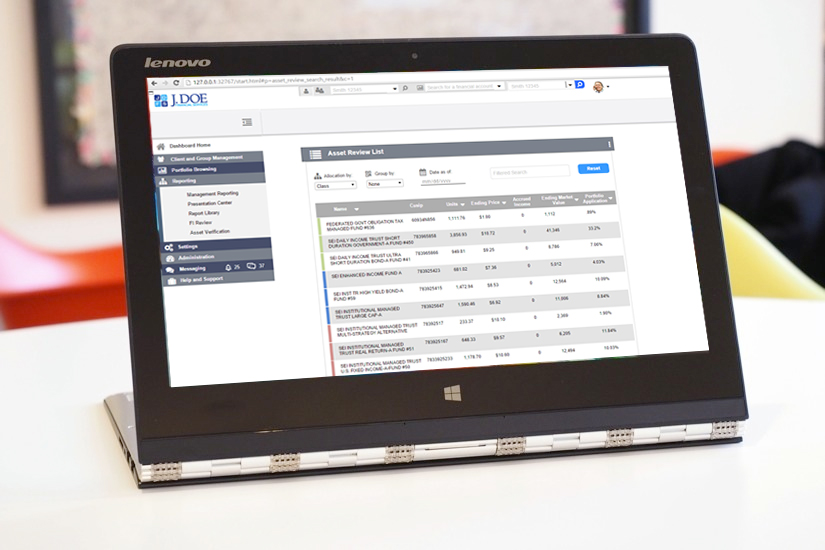 We not only build products, but we build products that build products. We have a unique history of application development and have a tool set that builds advanced applications used by millions of people world wide. Below is a brief snapshot of some of our products.
Anomaly Studios offers products and services to help business and institutions develop and manage Internet experiences with ease and efficiency. Healthcare organizations, entertainment venues, and the general public benefit from our advanced and easy-to-use interactive tools.
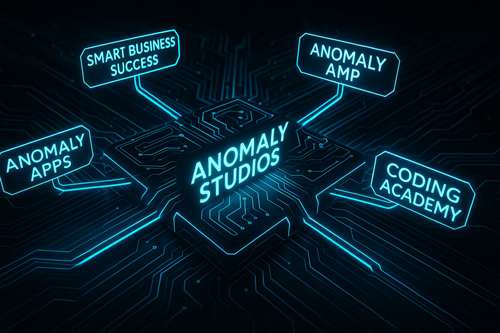
Anomaly Studios creates products that help people turn creativity into systems, and systems into freedom. Each product was born inside our studio to solve a real problem, and together, they form a connected ecosystem for entrepreneurs, educators, and creators who want to grow smarter, not harder.
Cutting Edge: Our clients in businesses, education, and healthcare reach unique demographics that are tech-savvy, socially connected, and understand good websites from bad websites. Many times these consumers make decisions about their preferred product, college, or doctors based on the organizations' websites. To attract and retain an audience, organizations must have websites with cutting-edge aesthetics and modern technology. People want to be able to view a website with their computer, iPhone, and iPad. All of these demands compound with needing something that is easy to update and manage. Our website solutions and products put the control in your hands.
 Scale your impact. Automate your freedom.
Anomaly AMP is our flagship SaaS platform that helps entrepreneurs and educators transform knowledge into recurring revenue.
It brings together everything needed to run a digital business from memberships, content delivery, community, and automation — all into one intuitive system.
Built for:
Features include:
AMP is where creativity meets compounding revenue, turning your expertise into a self-sustaining ecosystem.
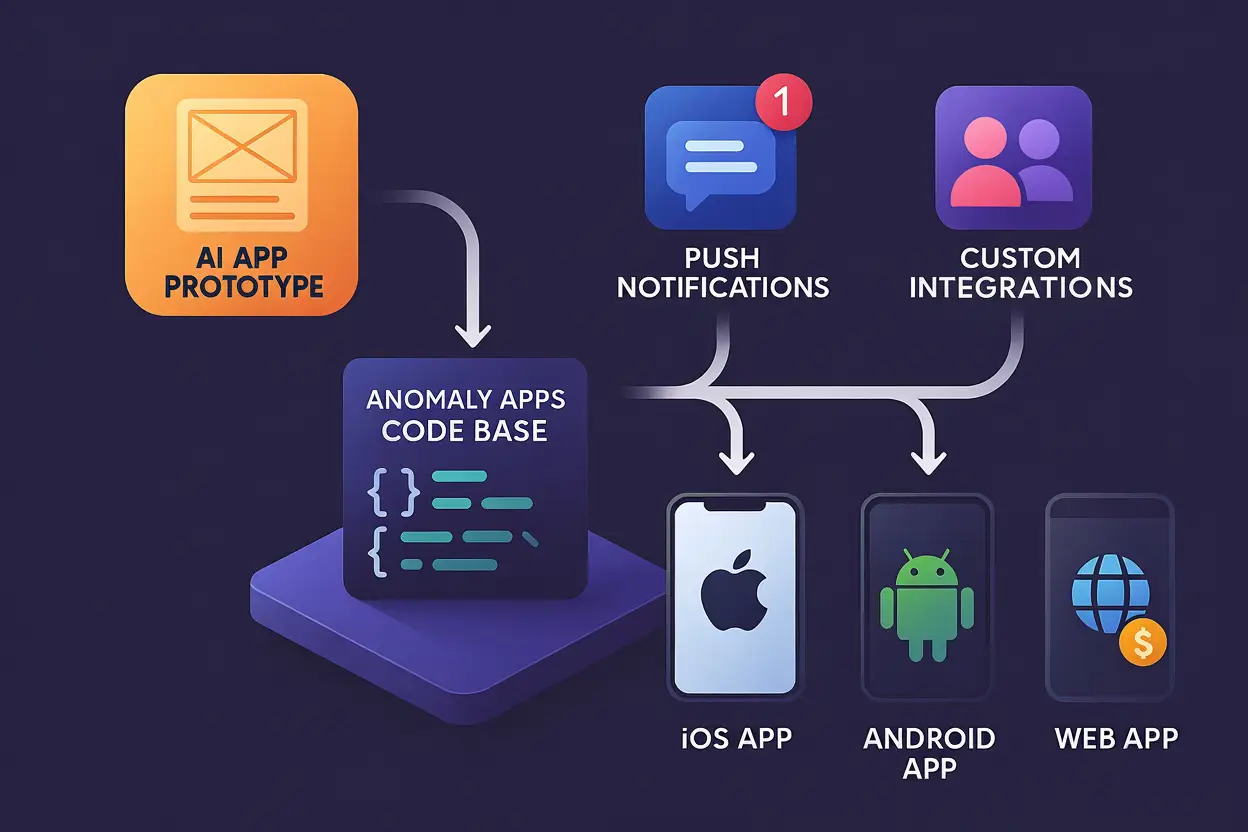 Code-powered architecture for the modern web.
Anomaly Apps is our proprietary framework for progressive web app development — the engine that powers AMP and our clients’ custom digital products.
It’s built for flexibility, scalability, and design precision, turning complex systems into elegant, adaptive experiences.
Capabilities include:
Anomaly Apps represents the code foundation behind everything we build — a framework where design and development move as one.
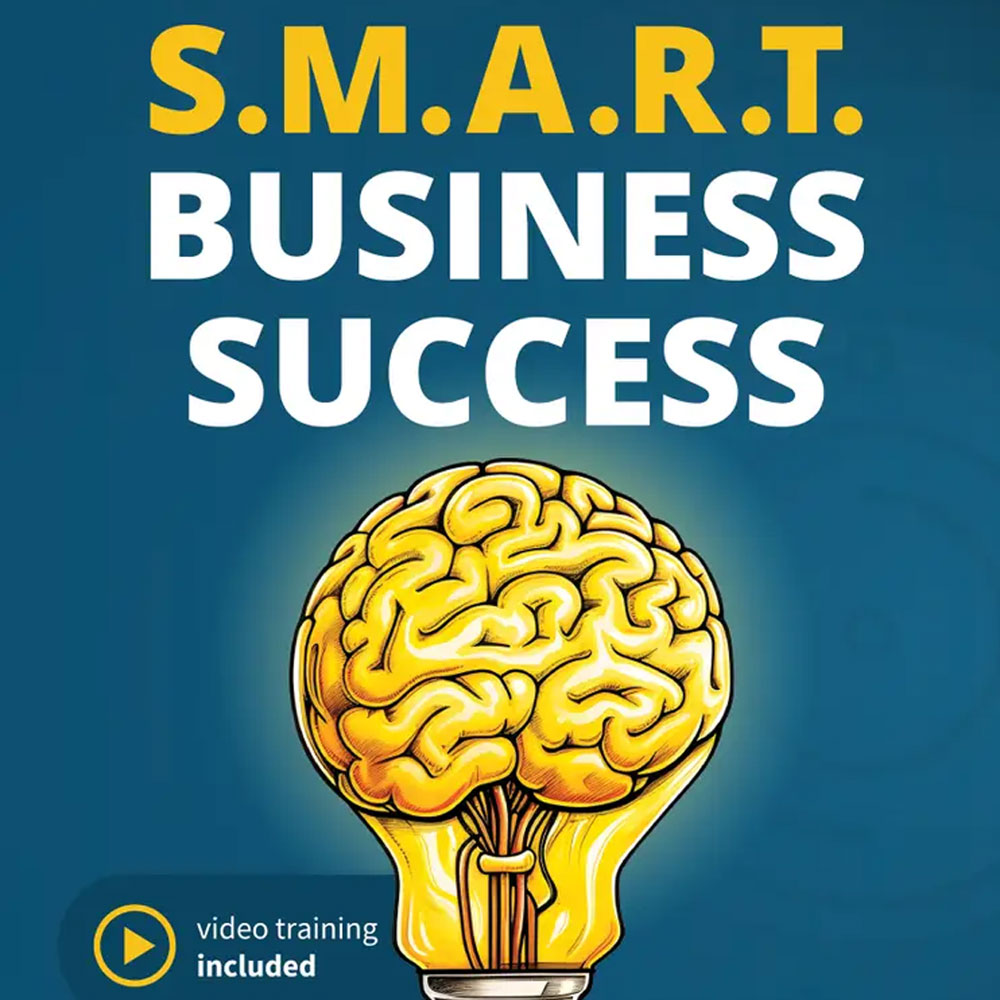 Systems thinking for entrepreneurs.
Smart Business Success is the business education platform of Anomaly Studios — a curriculum, book, video series, and mentorship ecosystem designed to help entrepreneurs scale through structure.
It’s where we teach the exact frameworks we use internally to automate, organize, and grow creative businesses.
Inside the system:
Smart Business Success helps business owners stop reinventing the wheel and start building the systems that set them free.
Get the SMART Business Success print or eBook and video series on Amazon here or Barnes and Noble here or iBooks here.


 codingAcademy/codingAcademyClassImage.jpg" alt="" width="500" height="500" />Teaching tomorrow’s makers today.
coding Academy introduces students to coding, animation, and design through creative, hands-on projects.
Built on Anomaly Studios’ education heritage and platform, it blends technology and storytelling to make learning interactive, relevant, and fun.
What students learn:
For:
The coding Academy helps the next generation learn not just how to code — but why creativity matters.
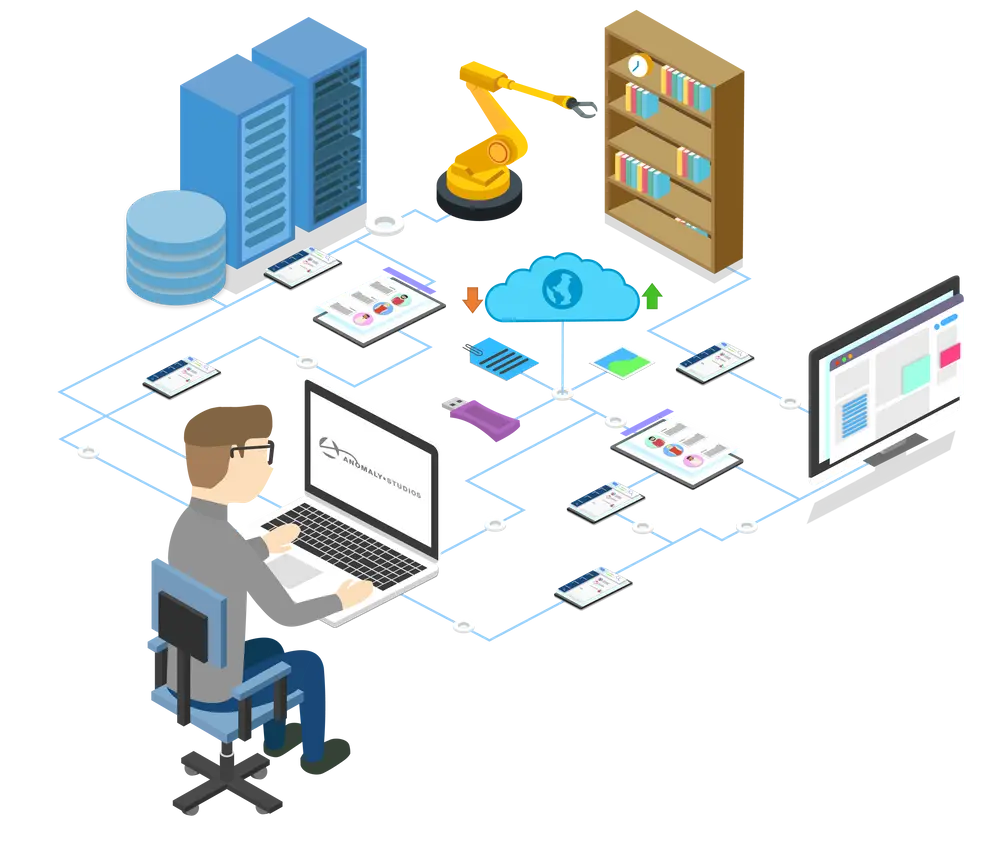 No matter which product you use, every Anomaly Studios system shares the same foundation:
Together, these principles create the Anomaly Ecosystem, where creativity, technology, and business all speak the same language.
Discovery Island
Discovery island is a digital learning game for kids. It is a fully online environment that reinforces Math and language arts concepts in a fun way. The game will work with any computer connected to the Internet. The game uniquely focuses on the development of interactive learning games for children in that is uses a modular-based approach to the game design. This game showcases the development of tools that promote effective solutions for interactive challenges-where the tools are infused with intelligence that adapt to the learners' skills and knowledge levels. Find out how you can deploy your own Discovery Island for your school by contacting us here.

Whether you’re scaling a membership, developing a custom platform, or building an educational program — we’ll help you design the system that powers it.
Test Drive
To arrange a demonstration of our web tools for education, entertainment, business, or healthcare, please contact us and we would be happy to show you the ways we can make your job easier and more efficient.
Services overview
Web and App Development
Branding & Visual Design
Animation & Motion Design
3D Modeling & Visualization
Content & Automation Systems
Education & Learning Systems
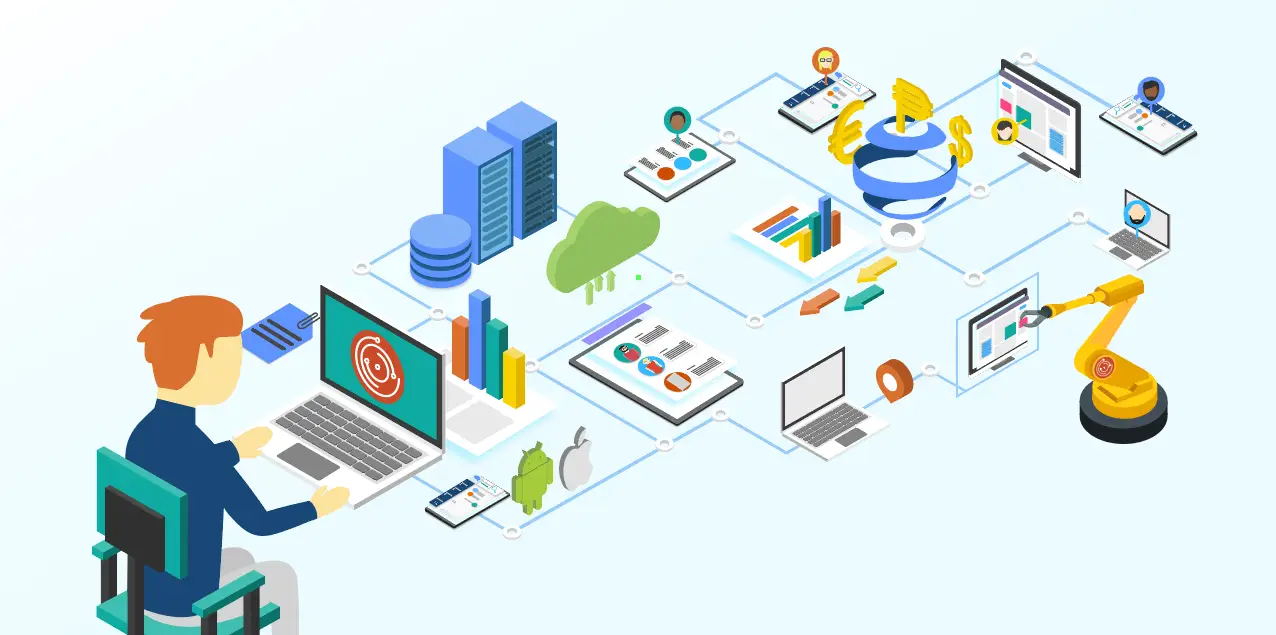 At Anomaly Studios, we build more than websites, we build platforms and digital ecosystems.
For over two decades, we’ve helped clients turn creative ideas into scalable systems that drive engagement, automate workflows, and grow revenue.
From brand design to full-stack development, animation to automation, we connect the creative and the technical into seamless, functional experiences.
Think. Design. Build. Automate. Scale.
Every engagement begins with listening — understanding your goals, challenges, and audiences. Then we map your ideas into actionable systems, prototype quickly, and deliver high-performance solutions designed for longevity.
We don’t hand off projects and disappear. We partner with you to architect sustainable growth.
 From ideas to infrastructure.
We craft web experiences that look beautiful, load fast, and scale effortlessly, powered by the same modular architecture that drives Anomaly AMP and Anomaly Apps.
What we deliver:
Why it matters: Your website should be a living system — one that adapts as you grow and connects every piece of your digital ecosystem.
Ease of Use: A big selling point with our websites is that you have powerful and easy to use content management features at your fingertips. Content management-based websites are sites that you DO NOT need to know any programming or HTML to perform updates. Our content management systems are point and click and easy to use. They take what normally is very hard and allows a single person or a team of people to manage any size of web site needs. Our web sites are scalable from one to any number of pages. Some of our clients have nearly 4,000 pages active and running at any given time.
Click here to view our powerful UX Design process that has empowered millions of happy users worldwide.
Strategy meets storytelling.
From logos to full campaigns, our design work builds brands that communicate clearly and feel cohesive across every touchpoint — print, web, social, and video.
Capabilities:
Brand identity & visual systems
Print collateral & packaging
Campaign and ad creative
Pitch decks and investor presentations
UI design for web & mobile
We blend Communication theory, visual design, and human psychology. This helps us ensure every design choice supports your goals and message.
Check Out Some of Our Visual Design Work
Spektral Motion Techno Rock Designs
Connecting creativity to consistency.
We design custom content pipelines and automation systems that keep your brand growing — even when you’re not online.
Integrations include:
CRM and email automation
AI-assisted content workflows
Video and podcast distribution systems
Social media automation and analytics
Member portals and e-learning integration
These same systems power Anomaly AMP, giving you a direct path to scale your own content-driven business.
As the creators behind Smart Business Success and coding Academy, we design educational experiences that turn information into transformation.
Our services include:
Whether you’re teaching entrepreneurship or coding to students, we’ll help you build a scalable learning system that lasts.
Experience
We can do things that many others can only dream up. Our team has many years experience in crafting engaging new media content. We have worked on projects in the areas of streaming Internet television, and entire interactive encyclopedia productions capable of warehousing hundreds of thousands of historical artifacts.
We are capable of creating robust PHP, mySQL, and ActionScript applications which are scalable and accessible amongst multiple platforms. The bottom line: We are capable of any project, any size. Our approach, as our clients will attest to, (see testimonials) is user-centric. This means your project is designed with your specific end-user in mind.
One Spot
Many firms today handle only design or only programming. We do both. This gives you, our client, one place to go and one point of contact to handle the visual design and programming tasks for your website. Project management can easily be facilitated through a single point of contact instead of your requests trickling through several outsourced firms, (sometimes spanning multiple continents).
Contact us today to figure out how our skills can complete your customized web site and programming needs.
Check Out Our Work
See how we helped the Top 10 Banks
View how we helped O'More College of Design
See our work for Williamson Medical Center
Check out our Online Game Development Chops
View our Online Learning Application
Our 3D modeling and rendering services help clients visualize the unseen — from products and spaces to data and ideas.
Applications:
We combine technical modeling precision with artistic direction to help audiences feel what you’re creating.
Check Out Our Work
3-D Modeling Solutions for BB&T Bank
Virtual 3-D Tours for Trevecca Nazarene University
Animation is in our DNA — it’s where Anomaly Studios began. We combine cinematic artistry with technical precision to create motion that educates, inspires, and captivates.
Offerings:
From short-form social videos to full productions, our motion work turns complex ideas into visual clarity.
Check Out Some Of Our Work
3-D Special Effects and Animation for Lifeway
In The Beginning There Were Dinosaurs Children's Cartoon
Experimental Animation: Metamorphosis
When you partner with Anomaly Studios, you’re not just hiring a team — you’re connecting to an ecosystem designed to multiply your impact.
Your next idea deserves a system that can support it.
Let’s map your vision, build the foundation, and scale it together.
Privacy Policy
Effective date: March 14, 2018, updated June 15th 2019
Anomaly Studios, LLC, also doing business as Anomaly Learning and the coding Academy ("company", "us", "we", or "our") operates the https://anomalystudios.com, https://learn.anomalystudios.com, https://classes.anomalystudios.com UnityXD, coding Academy websites and apps (the "Service").
This page informs you of our policies regarding the collection, use, and disclosure of personal data when you use our Service and the choices you have associated with that data.
We use your data to provide and improve the Service. By using the Service, you agree to the collection and use of information in accordance with this policy. Unless otherwise defined in this Privacy Policy, terms used in this Privacy Policy have the same meanings as in our Terms and Conditions, accessible from https://www.anomalystudios.com/terms-of-use-and-conditions
As stated in our Terms of Use, our website and Services are offered and available only to you, if you are (a) that You have not been previously suspended or removed from the Website by Anomaly Learning; (b) that You are either (i) at least 13 years of age or (ii) Your parent and/or guardian has consented to Your use of the Website; and (c) that your registration and your use of the Website is in compliance with any and all applicable laws and regulations.
We are obligated to ask for your explicit consent and give explicit terms of what users are giving consent to.
Personal Data or Personally Identifiable Information means data about a living individual who can be identified from those data (or from those and other information either in our possession or likely to come into our possession).
"processing" generally covers actions that can be performed in connection with data such as collection, use, storage and disclosure.
Usage Data is data collected automatically either generated by the use of the Service or from the Service infrastructure itself (for example, the duration of a page visit).
Cookies are small pieces of data stored on a User's device. Our website uses cookies to distinguish you from other users of our website. This helps us to provide you with a good experience when you browse our website and also allows us to improve our site. For example, by ensuring that users are finding what they are looking for easily.
Data Controller means the natural or legal person who (either alone or jointly or in common with other persons) determines the purposes for which and the manner in which any personal data are, or are to be, processed.
For the purpose of this Privacy Policy, we are a Data Controller of your data.
Data Processor (or Service Provider) means any natural or legal person (other than an employee of the Data Controller) who processes the data on behalf of the Data Controller.
We may use the services of various Service Providers in order to process your data more effectively.
Data Subject is any living individual who is using our Service and is the subject of Personal Data.
The User is the individual using our Service. The User corresponds to the Data Subject, who is the subject of Personal Data.
We collect several different types of information for various purposes to provide and improve our Service to you.
Our collection, use, and disclosure of Student Data are governed by our Privacy Policy and Terms of Use and also by the provision of the Family Educational Rights and Privacy Act (FERPA), the Children's Online Privacy Protection Act (COPPA), General Data Protection Regulation (GDPR), and applicable state laws that relate to the collection of Student Data.
Our cookies do not collect Personal Information or Children's Personal Information, and we do not combine the general information collected through these cookies with other Personal Information or Children's Personal Information to tell us who you are or what your user name or email address is.
If you come to our business through a sales affiliate, cookies are used to associate your account and information with the sales affiliate in order to calculate sales commissions.
While using our Service, we may ask you to provide us with certain personally identifiable information that can be used to contact or identify you ("Personal Data"). We only ask for Personally Identifiable Information where it is reasonably necessary to provide the Services. Personally identifiable information may include, but is not limited to:
We may use your Personal Data to contact you with newsletters, marketing or promotional materials and other information that may be of interest to you. You may opt out of receiving any, or all, of these communications from us by following the unsubscribe link or instructions provided in any email we send or by contacting us.
We may also collect information how the Service is accessed and used ("Usage Data"). This Usage Data may include information such as your computer's Internet Protocol address (e.g. IP address), browser type, browser version, the pages of our Service that you visit, the time and date of your visit, the time spent on those pages, unique device identifiers and other diagnostic data.
We may use and store information about your location if you give us permission to do so ("Location Data"). We use this data to provide features of our Service, to improve and customize our Service.
You can enable or disable location services when you use our Service at any time, through your device settings.
We use cookies and similar tracking technologies to track the activity on our Service and hold certain information.We may gather anonymous information about Users through cookie technology on an individual and aggregate level.
Cookies are files with small amount of data which may include an anonymous unique identifier. Cookies are sent to your browser from a website and stored on your device. Tracking technologies also used are beacons, tags, and scripts to collect and track information and to improve and analyze our Service.
Examples of Cookies we use:
Non-Personal Information
Web Beacons, also known as pixel tags and clear GIFs, ("Web Beacons"), are electronic images that allow a website to access cookies and help track marketing campaigns and general usage patterns of visitors to those websites. Web Beacons can recognize certain types of information, such as cookie numbers, time and date of a page view, and a description of the page where the Web Beacons are placed. No Personally Identifiable Information about you is shared with third parties through the use of Web Beacons on our website. However, through Web Beacons, we may collect general information that will not personally identify you, such as: Internet browser, operating system, date of visit, time of visit and path taken through the website.
When we collect usage information (such as the numbers and frequency of visitors to the Website), we only use this data in aggregate form, and not in a manner that would identify you personally. For example, this aggregate data tells us how often users use parts of the Services, so that we can make the Services appealing to as many users as possible. We may also provide this aggregate information to our partners; our partners may use such information to understand how often and in what ways people use our Services, so that they, too, can provide you with an optimal experience. We do not disclose aggregate information to a partner in a manner that would identify you personally.
We use tracking and cookies data for the following purposes:
Authentication and security. Cookies help authenticate your access to Anomaly Learning and prevent unauthorized parties from accessing your accounts.
Preferences. Cookies help us remember your settings on the pages you visit, so that we can display your preferred content the next time you visit, or preferred language or the country you're in, so we can provide content in your preferred language without asking each time you visit.
Analytics and research. Cookies help us test different versions of Anomaly Learning to see which features or content users prefer, web beacons help us determine which email messages are opened, and cookies help us see how you interact with Anomaly Learning, like the links you click on. We also work with a number of analytics partners, including Google Analytics, who use cookies and similar technologies to help us analyze how users use the Services.
Personalized content. Cookies help us provide more relevant content.
Advertising. To provide you with more relevant advertising. Note that advertising and targeting only happens through our marketing web pages. No marketing or advertising occurs within our platforms when you are logged into your account. We do this so that only advertising appears to parents and not to children. It is our practice and policy to never display advertising to children.
Improve Services. Cookies help us analyze user's experience with our services so that we may improve.
Some information is collected automatically by servers and the services that run the Internet. Additional Metadata is collected for data logs and for security to ensure our platform is a safe place for all. Automatic information collection is described below.
Google Analytics
We use a tool called "Google Analytics" to collect information about the users of our services. Google Analytics collects information such as how often users visit our website site, what pages they visit when they do so, and what other sites they used prior to coming to our website. We use the information we get from Google Analytics to analyze performance so we can improve our services, including to help customize our website for users.
Most browsers are initially set up to accept cookies, but you can reset your browser to refuse all cookies or to indicate when a cookie is being sent. However, some features and services (particularly those that require you to sign-in) may not function properly if your cookies are disabled. You may also set your email options to prevent the automatic downloading of images that may contain technologies that would allow us to know whether you have accessed our email and perform certain functions with it.
Through browser preferences, it is also possible to delete Cookies installed in the past, including the Cookies that may have saved the initial consent for the installation of Cookies by our website.
Users can, for example, find information about how to manage Cookies in the most commonly used browsers at the following addresses: Google Chrome, Mozilla Firefox, Apple Safari and Microsoft Internet Explorer.
With regard to Cookies installed by third parties, Users can manage their preferences and withdrawal of their consent by clicking the related opt-out link (if provided), by using the means provided in the third party's privacy policy, or by contacting the third party.
Notwithstanding the above, the Owner informs that Users may follow the instructions provided on the subsequently linked initiatives by the EDAA (EU), the Network Advertising Initiative (US) and the Digital Advertising Alliance (US), DAAC (Canada), DDAI (Japan) or other similar services. Such initiatives allow Users to select their tracking preferences for most of the advertising tools.
Anomaly Studios, LLC uses the collected data for various purposes:
If you are from the European Economic Area (EEA), our legal basis for collecting and using the personal information described in this Privacy Policy depends on the Personal Data we collect and the specific context in which we collect it.
We may process your Personal Data because:
Anomaly Studios, LLC will retain your Personal Data only for as long as is necessary for the purposes set out in this Privacy Policy and that the data is required to offer our services. We will retain and use your Personal Data to the extent necessary to comply with our legal obligations (for example, if we are required to retain your data to comply with applicable laws), resolve disputes, perform our services, and enforce our legal agreements and policies.
Anomaly Studios, LLC will also retain Usage Data for internal analysis purposes. Usage Data is generally retained for a shorter period of time, except when this data is used to strengthen the security or to improve the functionality of our Service, or we are legally obligated to retain this data for longer time periods.
You may exercise your right to request your personal information to be deleted by Anomaly Studios, LLC.
We will hold on to personal information only as long as is reasonably necessary for the purpose for which it was collected. We will securely dispose of it once you no longer have a legitimate reason for retaining it.l
Your information, including Personal Data, may be transferred to - and maintained on - computers located outside of your state, province, country or other governmental jurisdiction where the data protection laws may differ than those from your jurisdiction.
If you are located outside the United States and choose to provide information to us, please note that we transfer the data, including Personal Data, to United States and process it there.
Your consent to this Privacy Policy followed by your submission of such information represents your agreement to that transfer.
Anomaly Studios, LLC will take all steps reasonably necessary to ensure that your data is treated securely and in accordance with this Privacy Policy and no transfer of your Personal Data will take place to an organization or a country unless there are adequate controls in place including the security of your data and other personal information.
If you choose to use our Services from the European Union, please note the following information:
Anomaly Studios, LLC is based in the United States of America. Your personal information is therefore transferred outside the European Union ("EU") and European Economic Area ("EEA"). Such transfer is necessary for the performance of the contract between you Anomaly Studios, LLC
Your PII is also transferred to and processed by third party payment providers and your bank. Such transfers are necessary for performance of the contract between you and Anomaly Studios, LLC(article 49.1 (b) of the GDPR).
In order for us to provide the Services to you, your personal information will be transferred to, and stored at/processed in the United States. Your personal data may also be processed by staff operating outside the European Economic Area (EEA), such as in India and the Philippines, who work for us or for one of our suppliers. We will take all steps reasonably necessary to ensure that your personal data is treated securely and in accordance with this notice.
If you are a resident of the European Economic Area (EEA), you have certain data protection rights. Anomaly Studios, LLC aims to take reasonable steps to allow you to correct, amend, delete or limit the use of your Personal Data.
If you wish to be informed about what Personal Data we hold about you and if you want it to be removed from our systems, please contact us.
In certain circumstances, you have the following data protection rights:
Please note that we may ask you to verify your identity before responding to such requests.
You have the right to complain to a Data Protection Authority about our collection and use of your Personal Data. For more information, please contact your local data protection authority in the European Economic Area (EEA).
There are some kinds of information you should never provide without student permission including student names, numbers, citizenship, gender, ethnicity, religious and other preferences, grades, GPAs, and class schedules or any other identifiable information.
We may use data which has been de-identified and/or aggregated for product development, research, analytics and other purposes, including for the purpose of analyzing, improving, or marketing the Anomaly Studios, LLC Services. In certain occasions, Anomaly Studios, LLC may share this data with business partners to improve our services or offerings. If we disclose information to authorized business partners to conduct research on online education or assist in understanding the usage, viewing, and demographic patterns for certain programs, content, services, promotions, and/or functionality on our Service, such data will be aggregated and/or anonymized to reasonably avoid identification of a specific individual.
If Anomaly Studios, LLC is involved in a merger, acquisition or asset sale, your Personal Data may be transferred. We will provide notice before your Personal Data is transferred and becomes subject to a different Privacy Policy.
Under certain circumstances, Anomaly Studios, LLC may be required to disclose your Personal Data if required to do so by law or in response to valid requests by public authorities (e.g. a court or a government agency).
Anomaly Studios, LLC may disclose your Personal Data in the good faith belief that such action is necessary to:
The security of your data is important to us, but remember that no method of transmission over the Internet, or method of electronic storage is 100% secure. While we strive to use commercially acceptable means to protect your Personal Data, we cannot guarantee its absolute security.
We do not support Do Not Track ("DNT"). Do Not Track is a preference you can set in your web browser to inform websites that you do not want to be tracked.
You can enable or disable Do Not Track by visiting the Preferences or Settings page of your web browser.
Anomaly Studios, LLC aims to take reasonable steps to allow you to correct, amend, delete, or limit the use of your Personal Data.
Whenever made possible, you can update your Personal Data directly within your account settings section. If you are unable to change your Personal Data, please contact us to make the required changes.
If you wish to be informed what Personal Data we hold about you and if you want it to be removed from our systems, please contact us.
Schools must annually notify parents of students and eligible students in attendance of their rights under FERPA.
In certain circumstances, you have the right:
You have the right to data portability for the information you provide to Anomaly Studios, LLC. You can request to obtain a copy of your Personal Data in a commonly used electronic format so that you can manage and move it.
Please note that we may ask you to verify your identity before responding to such requests.
We may employ third party companies and individuals to facilitate our Service ("Service Providers"), to provide the Service on our behalf, to perform Service-related services or to assist us in analyzing how our Service is used.
These third parties may have access to your Personal Data only to perform these tasks on our behalf and are obligated not to disclose or use it for any other purpose. Not all providers below will have your data as this is a full representation of 3rd party providers for all our customers servicing a variety of contracts for platforms and services. Only data that is needed for the delivery of the Service is shared with providers to administer the Service.
We may use third-party Service Providers to monitor and analyze the use of our Service.
We may use third-party Service Providers to show advertisements to you to help support and maintain our Service.
Anomaly Studios, LLC uses remarketing services to advertise on third party websites to you after you visited our Service. We and our third-party vendors use cookies to inform, optimize and serve ads based on your past visits to our Service.
We may provide paid products and/or services within the Service. In that case, we use third-party services for payment processing (e.g. payment processors).
We will not store or collect your payment card details. That information is provided directly to our third-party payment processors whose use of your personal information is governed by their Privacy Policy. These payment processors adhere to the standards set by PCI-DSS as managed by the PCI Security Standards Council, which is a joint effort of brands like Visa, Mastercard, American Express and Discover. PCI-DSS requirements help ensure the secure handling of payment information.
The payment processors we work with are:
Our Service may contain links to other sites that are not operated by us. If you click on a third party link, you will be directed to that third party's site. We strongly advise you to review the Privacy Policy of every site you visit. We have no control over and assume no responsibility for the content, privacy policies or practices of any third party sites or services.
We believe that protecting the privacy of all people is of paramount importance. Protecting the privacy of children is especially important. For that reason we will never collect or maintain information that is not necessary for the delivery of the Service. For account holders of student accounts we only collect a Pseudonym (nick name), username, and password to login to our services. This information is never shared or publicly displayed. Our Service does not address anyone under the age of 13 ("Children") as parents must create and maintain the account.
We do not knowingly collect personally identifiable information from anyone under the age of 13. If you are a parent or guardian and you are aware that your Children has provided us with Personal Data, please contact us. If we become aware that we have collected Personal Data from children without verification of parental consent, we take steps to remove that information from our servers.
We are proud supporters of the Student Privacy Pledge. Our collection and use of Student Records is governed by our contracts with the Schools, by our Privacy Policy, and by applicable privacy laws. For example, we work with Schools to help protect personal information from the Student's educational record, as required by the Family Educational Rights and Privacy Act ("FERPA"), and to protect the personal information of students under 13 consistent with the Children's Online Privacy Protection Act ("COPPA"). If you have any questions about reviewing, modifying, or deleting the personal information of a School User accessing the Service through a School partner agreement, please contact your School directly.
When our Service is used by a School in an educational setting, we may rely on the School to provide the requisite consent from the child's parents for Anomaly Studios, LLC to collect information from a School User under the age of 13. Look at our Terms of service to see more details on consent for children to use our services
Teachers can create accounts on behalf of Students. When registering an account for a Student who is under the age of 13 (a "Child"), the Teacher represents and warrants that they or the educational organization they work for has proper permission to register the Child to use our services.
By registering and creating an account for your child, your child will not be able to share information, including photos, videos, audio, and location, publicly and with others. If your child shares information publicly, it would have to be outside of our system and it is strongly advised to not do so as it may be indexable by search engines like Google Search. We are not responsible for the content uploaded by any user.
Anomaly Studios, LLC will not serve personalized ads to your child, which means ads will not be based on information from your child's account. Instead, ads may be served to a parent or teacher if they have visited our website for marketing purposes. Your child will never be served ads served by other (non-Google) ad providers, including ads personalized by third parties because we never advertise to children.
We may update our Privacy Policy from time to time. We will notify you of any changes by posting the new Privacy Policy on this page.
We will let you know via email and/or a prominent notice on our Service, prior to the change becoming effective and update the "effective date" at the top of this Privacy Policy.
You are advised to review this Privacy Policy periodically for any changes. Changes to this Privacy Policy are effective when they are posted on this page.
If you have any questions about this Privacy Policy, please contact us:
Terms of Use and Conditions
Effective date: March 14, 2018, updated June 15th 2019
Anomaly Studios, LLC, also doing business as Anomaly Learning and the coding Academy ("company", "us", "we", or "our") operates the https://anomalystudios.com, https://learn.anomalystudios.com, https://classes.anomalystudios.com UnityXD, coding Academy websites and apps (the "Service").
You should read this entire Terms and Conditions and also our Privacy Policy. Your access to and use of the Service is conditioned upon your acceptance of and compliance with these Terms. These Terms apply to all visitors, users and others who wish to access or use the Service.
By accessing or using the Service you agree to be bound by these Terms. If you disagree with any part of the terms then you do not have permission to access the Service.
If you are under the age of 18, STOP!
You must get your parent or legal guardian to read and accept this Agreement.
The Service is not available to (a) any users previously suspended or removed from the website by anomaly learning or (b) any persons under the age of 13 whose registration has not been approved by a legal parent or guardian.
By clicking the "I Agree" button or by otherwise using or registering an account for the Website, You represent:
(a) that You have not been previously suspended or removed from the Website by Anomaly Learning;
(b) that You are either:
(i) at least 13 years of age or
(ii) Your parent and/or guardian has consented to Your use of the Website;
(c) that your registration and your use of the Website is in compliance with any and all applicable laws and regulations.
We take steps to minimize the collection of personally identifiable information from Users under the age of 13 as explained in the privacy policy. We are committed to protecting your privacy, and have developed our privacy practices to align with applicable laws, including the Family Educational Rights and Privacy Act (FERPA) and the Children's Online Privacy Protection Act (COPPA).
Anomaly Learning does not permit children under the age of 13 (a "Child" or "Children") to create an account without the consent and at the direction of a Parent or School. Please contact us at [email protected] if you believe we have inadvertently collected information from a child under 13 without parental consent so that we may delete the information as soon as possible.
When Anomaly Learning is used by a School in an educational setting, we may rely on the School to provide the requisite consent from the child's parents for Anomaly Learning to collect information from a School User under the age of 13.
Additionally, a Child User may use the Website if registered through certain educational organizations and through which education organization the legal parent and/or guardian of such Child User has consented to use the Services. Further, in certain instances, a Child User may use our Service via a third party application that integrate into or with the Services. A Child User that has registered through such external educational organizations, third party applications, or Teachers will only be permitted to use the Service for so long as Anomaly Learning reasonably believes that such access has been consented to by the Child User's parent or guardian.
If you are signing up for this Service and creating accounts on behalf of student(s), you represent and warrant that you are either (a) a teacher or school administrator or otherwise authorized by a school or district to sign up on behalf of students or (b) the parent of such student(s). If you are a school, district, or teacher, you represent and warrant that you are solely responsible for complying with COPPA, meaning that you must obtain advance written consent from all parents or guardians whose children under 13 will be accessing the Services. When obtaining consent, you must provide parents and guardians with these Terms, and our Privacy Policy
You must keep all consents on file and provide them to us if we request them. If you are a teacher, you represent and warrant that you have permission and authorization from your school and/or district to use the Services as part of your curriculum, and for purposes of COPPA compliance, you represent and warrant that you are entering into these Terms on behalf of your school and/or district.
You represent and warrant that you are of legal age to form a binding contract (or if not, you've received your parent's or guardian's permission to use the Services and gotten your parent or guardian to agree to these Terms on your behalf, as we described earlier, and also to agree to these Terms and their own behalf). If you're agreeing to these Terms on behalf of an organization or entity (for example, if you're an administrator agreeing to these Terms on behalf of your district), you represent and warrant that you are authorized to agree to these Terms on that organization or entity's behalf and bind them to these Terms. You also certify that you are legally permitted to use and access the Services and take full responsibility for the selection and use of and access to the Services. This Agreement is void where prohibited by law, and the right to access the Services is revoked in such jurisdictions.
The only Children's Personal Information we require is your parent's email address so we can initiate a parental consent process, as well as non-personal information such as your screen name and password.
We only collect personal information through the Services from a child under 13 where that student's school, district, and/or teacher has agreed (via the terms described in the following paragraphs) to obtain parental consent for that child to use the Services and disclose personal information to us or where the parent or legal guardian of a child has signed the child up to use the Services.
We do not disclose any other information about students, and students assume full responsibility for the disclosure and use of any other personal information the Student chooses to disclose to any User on the Sites, which at all times shall be subject to the terms of our Privacy Policy.
We will never share Education Records with third parties except: as directed by a user (i.e., teacher sharing with another teacher or parent); or to our service providers that are necessary for us to provide the Software, as stated in our Privacy Policy.
In cases where you have authorized or registered another individual, including minor children under the age of 13, to use your account, you are fully responsible for the online conduct of such person, controlling that person's access to and use of the Sites and Services, and the consequences of any misuse by that person. When a student turns 18 years old, or enters a postsecondary institution at any age, the rights under FERPA transfer from the parents to the student ("eligible student").
California Children's Privacy Rights
If you are under the age of 18 residing in California, you are entitled to request removal of content or
information you have posted publicly on our Service.
Please also read our Privacy Policy concerning children below ages of 13 and our adherence to the Children's Online Privacy Protection Act (COPPA) and the Family Educational Rights Privacy Act (FERPA).
By creating an Account on our service, you agree to subscribe to newsletters, marketing or promotional materials and other information we may send. However, you may opt out of receiving any, or all, of these communications from us by following the unsubscribe link or instructions provided in any email we send. We may offer promotional trial subscriptions to access the Services for free or at special discounted prices. If you sign up for a trial subscription, your rights to use the Services are limited by the terms of such trial and will terminate or renew according to the terms of your trial arrangement and/or any applicable Additional Terms.
If you wish to purchase any product or service made available through the Service ("Purchase"), you may be asked to supply certain information relevant to your Purchase including, without limitation, your credit card number, the expiration date of your credit card, your billing address, and your shipping information.
You represent and warrant that: (i) you have the legal right to use any credit card(s) or other payment method(s) in connection with any Purchase; and that (ii) the information you supply to us is true, correct and complete.
The service may employ the use of third party services for the purpose of facilitating payment and the completion of Purchases. By submitting your information, you grant us the right to provide the information to these third parties subject to our Privacy Policy.
We reserve the right to refuse or cancel your order at any time for reasons including but not limited to: product or service availability, errors in the description or price of the product or service, error in your order or other reasons.
We reserve the right to refuse or cancel your order if fraud or an unauthorized or illegal transaction is suspected.
We are constantly updating product and service offerings on the Service. We may experience delays in updating information on the Service and in our advertising on other web sites. The information found on the Service may contain errors or inaccuracies and may not be complete or current. Products or services may be mispriced, described inaccurately, or unavailable on the Service and we cannot guarantee the accuracy or completeness of any information found on the Service.
We therefore reserve the right to change or update information and to correct errors, inaccuracies, or omissions at any time without prior notice.
Any contests, sweepstakes or other promotions (collectively, "Promotions") made available through the Service may be governed by rules that are separate from these Terms & Conditions. If you participate in any Promotions, please review the applicable rules as well as our Privacy Policy. If the rules for a Promotion conflict with these Terms and Conditions, the Promotion rules will apply.
Some parts of the Service are billed on a subscription basis ("Subscription(s)"). You will be billed in advance on a recurring and periodic basis ("Billing Cycle"). Billing cycles are set either on a monthly or annual basis, depending on the type of subscription plan you select when purchasing a Subscription.
At the end of each Billing Cycle, your Subscription will automatically renew under the exact same conditions unless you cancel it or Anomaly Studios, LLC cancels it. You may cancel your Subscription renewal either through your online account management page or by contacting Anomaly Studios, LLC customer support team.
A valid payment method, including credit card or PayPal, is required to process the payment for your Subscription. You shall provide Anomaly Studios, LLC with accurate and complete billing information including full name, address, state, zip code, telephone number, and a valid payment method information. By submitting such payment information, you automatically authorize Anomaly Studios, LLC to charge all Subscription fees incurred through your account to any such payment instruments.
Should automatic billing fail to occur for any reason, Anomaly Studios, LLC will issue an electronic invoice indicating that you must proceed manually, within a certain deadline date, with the full payment corresponding to the billing period as indicated on the invoice.
Anomaly Studios, LLC may, at its sole discretion, offer a Subscription with a free trial for a limited period of time ("Free Trial").
You may be required to enter your billing information in order to sign up for the Free Trial.
If you do enter your billing information when signing up for the Free Trial, you will not be charged by Anomaly Studios, LLC until the Free Trial has expired. On the last day of the Free Trial period, unless you cancelled your Subscription, you will be automatically charged the applicable Subscription fees for the type of Subscription you have selected.
At any time and without notice, Anomaly Studios, LLC reserves the right to (i) modify the terms and conditions of the Free Trial offer, or (ii) cancel such Free Trial offer.
Anomaly Studios, LLC, in its sole discretion and at any time, may modify the Subscription fees for the Subscriptions. Any Subscription fee change will become effective at the end of the then-current Billing Cycle.
Anomaly Studios, LLC will provide you with a reasonable prior notice of any change in Subscription fees to give you an opportunity to terminate your Subscription before such change becomes effective.
Your continued use of the Service after the Subscription fee change comes into effect constitutes your agreement to pay the modified Subscription fee amount.
Except when required by law, paid Subscription fees are non-refundable by default but could be approved by Anomaly Studios, LLC.
Our Service allows you to post, link, store, share and otherwise make available certain information, text, graphics, videos, or other material ("Content"). You are responsible for the Content that you post on or through the Service, including its legality, reliability, and appropriateness.
You consent to our publication of User-Generated Content (with the exception of recordings) generated through your Account by any Child Users so long as the publication cannot be used to particularly identify such Child Users.
Anomaly Learning does not knowingly collect or store any personal information from or about children under the age of 13. We will delete such information if we become aware that it has been submitted through our website.
By posting Content on or through the Service, You represent and warrant that: (i) the Content is yours (you own it) and/or you have the right to use it and the right to grant us the rights and license as provided in these Terms, and (ii) that the posting of your Content on or through the Service does not violate the privacy rights, publicity rights, copyrights, contract rights or any other rights of any person or entity. We reserve the right to terminate the account of anyone found to be infringing on a copyright.
You retain any and all of your rights to any Content you submit, post or display on or through the Service and you are responsible for protecting those rights. We take no responsibility and assume no liability for Content you or any third party posts on or through the Service. However, by posting Content using the Service you grant us the right and license to use, modify, publicly perform, publicly display, reproduce, and distribute such Content on and through the Service. You agree that this license includes the right for us to make your Content available to other users of the Service, who may also use your Content subject to these Terms.
Anomaly Studios, LLC has the right but not the obligation to monitor and edit all Content provided by users.
In addition, Content found on or through this Service are the property of Anomaly Studios, LLC or used with permission. You may not distribute, modify, transmit, reuse, download, repost, copy, or use said Content, whether in whole or in part, for commercial purposes or for personal gain, without express advance written permission from us.
The Services are backed by our Child Safe Guarantee. This means that accounts will never include any pop-up ads or other advertisements directed to children.
When you create an account with us, you guarantee that you are above the age of 18, and that the information you provide us is accurate, complete, and current at all times. (For educational institutions, see below for student accounts). Inaccurate, incomplete, or obsolete information may result in the immediate termination of your account on the Service.
You are responsible for maintaining the confidentiality of your account and password, including but not limited to the restriction of access to your computer and/or account. You agree to accept responsibility for any and all activities or actions that occur under your account and/or password, whether your password is with our Service or a third-party service. You must notify us immediately upon becoming aware of any breach of security or unauthorized use of your account.
You may not use as a username the name of another person or entity or that is not lawfully available for use, a name or trademark that is subject to any rights of another person or entity other than you, without appropriate authorization. You may not use as a username any name that is offensive, vulgar or obscene.
We reserve the right to refuse service, terminate accounts, remove or edit content, or cancel orders in our sole discretion.
You need an account for most activities on our platform, including to purchase and enroll in a course or to submit a course for publication. When setting up and maintaining your account, you must provide and continue to provide accurate and complete information, including a valid email address. You will also be asked to provide a password in connection with you account.
You may register for an account to use our services by using an email account only if certain conditions below apply:
1. You are a student with a personal email account you want to use for our services and you are either:
a. 18 years old or older or
b. Have consent from your parents or legal guardian to have one and use it for our services.
2. You are a student that would like to use your legal parent's email account and has consent from your legal parent to do so.
3. You are a school or school representative that has provided email accounts to students and has permission from the student's parent's or legal guardians to use the service. You must be a teacher or school administrator or otherwise authorized by a school or district to sign up on behalf of students.
If you are a school, district, or teacher, you represent and warrant that you are solely responsible for complying with COPPA, meaning that you must obtain advance written consent from all parents or guardians whose children under 13 will be accessing the Services. When obtaining consent, you must provide parents and guardians with these Terms and our Privacy Policy. You must keep all consents on file and provide them to us if we request them. If you are a teacher, you represent and warrant that you have permission and authorization from your school and/or district to use the Services as part of your curriculum, and for purposes of COPPA compliance, you represent and warrant that you are entering into these Terms on behalf of your school and/or district.
You represent and warrant that you are of legal age to form a binding contract (or if not, you've received your parent's or guardian's permission to use the Services and gotten your parent or guardian to agree to these Terms on your behalf, as we described earlier, and also to agree to these Terms and their own behalf). If you're agreeing to these Terms on behalf of an organization or entity (for example, if you're an administrator agreeing to these Terms on behalf of your district), you represent and warrant that you are authorized to agree to these Terms on that organization or entity's behalf and bind them to these Terms. You also certify that you are legally permitted to use and access the Services and take full responsibility for the selection and use of and access to the Services. This Agreement is void where prohibited by law, and the right to access the Services is revoked in such jurisdictions.
If you register, approve the registration of, or otherwise assume responsibility for any child user, you represent and warrant that you are such child user's legal parent or guardian and you agree to be bound by the terms on behalf of such child user, including without limitation being liable for all use of the website by the child user. You acknowledge that Anomaly Learning may choose, but is not obligated, to make any inquiries, either directly or through third parties, that Anomaly Learning deems necessary to validate your registration information, including without limitation engaging third parties to provide verification services. Anomaly Learning reserves all rights to take legal actions against anyone who misrepresents personal information or is otherwise untruthful about their identity. Notwithstanding the foregoing, you acknowledge that Anomaly Learning cannot guarantee the accuracy of any information submitted by any user and Anomaly Learning is not obligated to verify the identity of any user, including any user's claim to be a parent user, or to verify that a parent identified by a child user or a teacher during registration is such child user's actual parent or guardian. A parent user account, along with all associated child user accounts, may be terminated by Anomaly Learning at any time and without warning for any failure to abide by these terms.
You are responsible for maintaining the confidentiality of your account and password, including but not limited to the restriction of access to your computer and/or account. You agree to accept responsibility for any and all activities or actions that occur under your account and/or password, including your disclosure of your personally identifiable information or the personally identifiable information of the child you are giving consent to use our services, whether your password is with our Service or a third-party service. You must notify us immediately upon becoming aware of any breach of security or unauthorized use of your account.
We are committed to protecting your privacy, and has developed our privacy practices to align with applicable laws, including the Family Educational Rights and Privacy Act (FERPA) and the Children's Online Privacy Protection Act (COPPA).
You may not use as a username the name of another person or entity or that is not lawfully available for use, a name or trademark that is subject to any rights of another person or entity other than you, without appropriate authorization. You may not use as a username any name that is offensive, vulgar or obscene.
We reserve the right to refuse service, terminate accounts, remove or edit content, or cancel orders in our sole discretion.
We respect the intellectual property rights of others. It is our policy to respond to any claim that Content posted on the Service infringes on the copyright or other intellectual property rights ("Infringement") of any person or entity.
If you are a copyright owner, or authorized on behalf of one, and you believe that the copyrighted work has been copied in a way that constitutes copyright infringement, please submit your claim via email to [email protected], with the subject line: "Copyright Infringement" and include in your claim a detailed description of the alleged Infringement as detailed below, under "DMCA Notice and Procedure for Copyright Infringement Claims"
You may be held accountable for damages (including costs and attorneys' fees) for misrepresentation or bad-faith claims on the infringement of any Content found on and/or through the Service on your copyright.
You may submit a notification pursuant to the Digital Millennium Copyright Act (DMCA) by providing our Copyright Agent with the following information in writing (see 17 U.S.C 512(c)(3) for further detail):
You can contact our Copyright Agent via email at [email protected]
The Service and its original content (excluding Content provided by users), features and functionality are and will remain the exclusive property of Anomaly Studios, LLC and its licensors. The Service is protected by copyright, trademark, and other laws of both the United States and foreign countries. Our trademarks and trade dress may not be used in connection with any product or service without the prior written consent of Anomaly Studios, LLC.
Our Service may contain links to third party web sites or services that are not owned or controlled by Anomaly Studios, LLC. Our Service may contain links to other sites that are not operated by us. If you click on a third party link, you will be directed to that third party's site. We strongly advise you to review the Privacy Policy of every site you visit. We have no control over and assume no responsibility for the content, privacy policies or practices of any third party sites or services.
Anomaly Studios, LLC has no control over, and assumes no responsibility for the content, privacy policies, or practices of any third party web sites or services. We do not warrant the offerings of any of these entities/individuals or their websites.
You acknowledge and agree that Anomaly Studios, LLC shall not be responsible or liable, directly or indirectly, for any damage or loss caused or alleged to be caused by or in connection with use of or reliance on any such content, goods or services available on or through any such third party web sites or services.
We strongly advise you to read the terms and conditions and privacy policies of any third party web sites or services that you visit.
We may terminate or suspend your account and bar access to the Service immediately, without prior notice or liability, under our sole discretion, for any reason whatsoever and without limitation, including but not limited to a breach of the Terms.
If you wish to terminate your account, you may simply discontinue using the Service.
All provisions of the Terms which by their nature should survive termination shall survive termination, including, without limitation, ownership provisions, warranty disclaimers, indemnity and limitations of liability.
You agree to defend, indemnify and hold harmless Anomaly Studios, LLC and its licensee and licensors, and their employees, contractors, agents, officers and directors, from and against any and all claims, damages, obligations, losses, liabilities, costs or debt, and expenses (including but not limited to attorney's fees), resulting from or arising out of a) your use and access of the Service, by you or any person using your account and password; b) a breach of these Terms, or c) Content posted on the Service.
In no event shall Anomaly Studios, LLC, nor its directors, employees, partners, agents, suppliers, or affiliates, be liable for any indirect, incidental, special, consequential or punitive damages, including without limitation, loss of profits, data, use, goodwill, or other intangible losses, resulting from (i) your access to or use of or inability to access or use the Service; (ii) any conduct or content of any third party on the Service; (iii) any content obtained from the Service; and (iv) unauthorized access, use or alteration of your transmissions or content, whether based on warranty, contract, tort (including negligence) or any other legal theory, whether or not we have been informed of the possibility of such damage, and even if a remedy set forth herein is found to have failed of its essential purpose.
Your use of the Service is at your sole risk. The Service is provided on an "AS IS" and "AS AVAILABLE" basis. The Service is provided without warranties of any kind, whether express or implied, including, but not limited to, implied warranties of merchantability, fitness for a particular purpose, non-infringement or course of performance.
Anomaly Studios, LLC and its subsidiaries, affiliates, and its licensors do not warrant that a) the Service will function uninterrupted, secure or available at any particular time or location; b) any errors or defects will be corrected; c) the Service is free of viruses or other harmful components; or d) the results of using the Service will meet your requirements.
Some jurisdictions do not allow the exclusion of certain warranties or the exclusion or limitation of liability for consequential or incidental damages, so the limitations above may not apply to you.
These Terms shall be governed and construed in accordance with the laws of Tennessee, United States, without regard to its conflict of law provisions.
Our failure to enforce any right or provision of these Terms will not be considered a waiver of those rights. If any provision of these Terms is held to be invalid or unenforceable by a court, the remaining provisions of these Terms will remain in effect. These Terms constitute the entire agreement between us regarding our Service, and supersede and replace any prior agreements we might have had between us regarding the Service.
We reserve the right, at our sole discretion, to modify or replace these Terms at any time. If a revision is material we will provide at least 30 days notice prior to any new terms taking effect. What constitutes a material change will be determined at our sole discretion.
By continuing to access or use our Service after any revisions become effective, you agree to be bound by the revised terms. If you do not agree to the new terms, you are no longer authorized to use the Service.
If you have any questions about these Terms, please contact us.
I don’t like the word, facilitation
Here is a helpful explanation of facilitated learning:
Facilitated learning is where the students are encouraged to take more control of their learning process. The trainer's role becomes that of a facilitator and organiser providing resources and support to learners. In turn the participants learn with and from each other as they identify and implement solutions to challenges, problems or other developmental issues. They might also set their own objectives and be responsible for learning assessment.
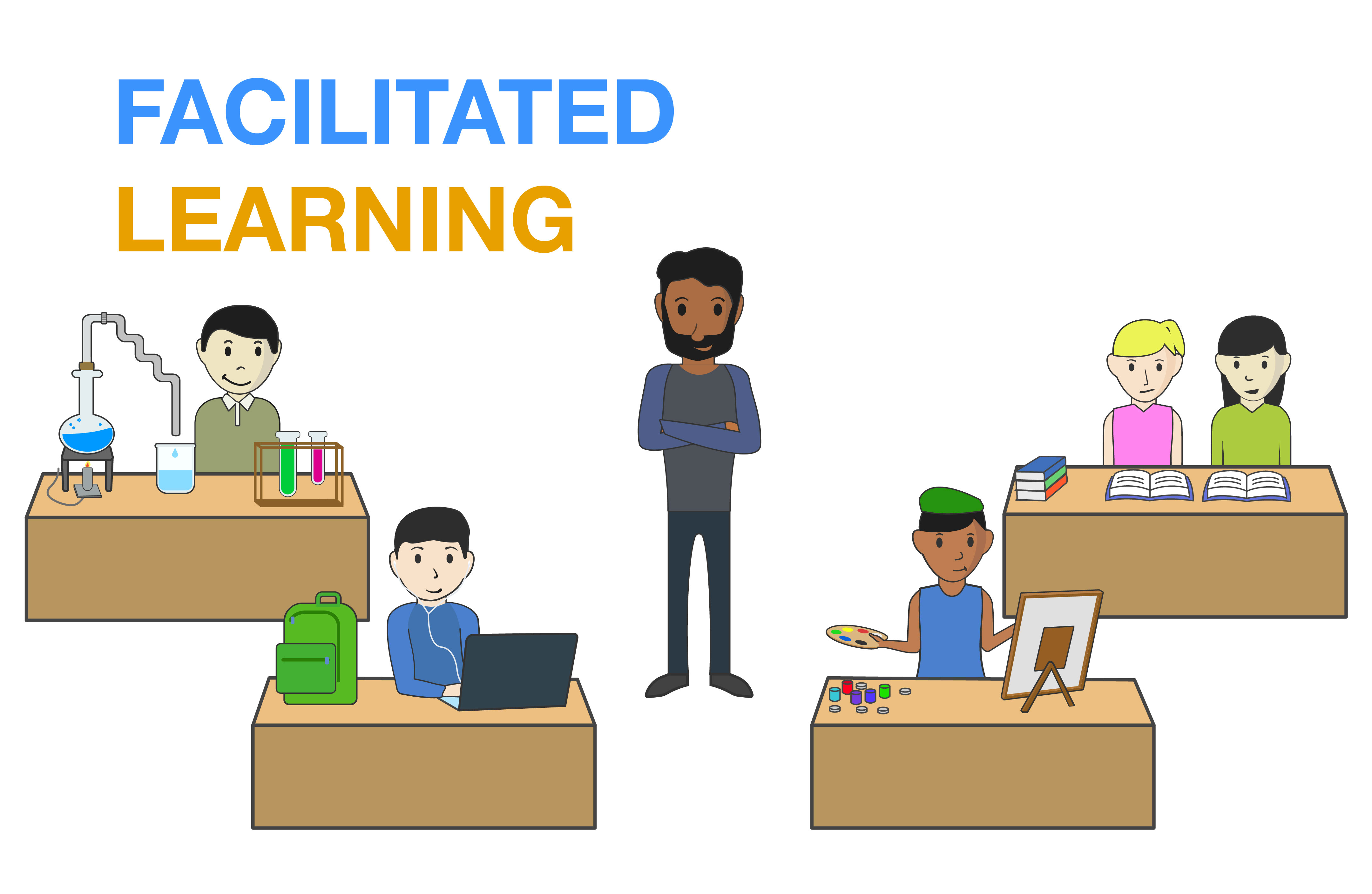
This is from the International Council on Archives and they further suggest:
Facilitated learning is based on the premise that the more responsibility a student takes for his/her own learning, the more effective the training or education will be. The advantages are:
The "downside" is that there is no exact role for the teacher. That is, while there are huge benefits and various different instructional design choices that can be made, the reality is that the teacher must be adaptable and creative and flexible in order to truly support students throughout. Therefore, in this case, vague is good! The teacher facilitator moves with the flow of the learning process and that is truly a benefit.
TIP: "Dynamic Teaching = Flexibility and Adaptability" - Ruth Reynard
Coming up next, "How does coding relate to hands-on?" Stay tuned...
How Does coding Relate to Hands-On
coding is now being discussed and implemented in STEM education courses and programs throughout the curriculum. It is now common knowledge that coding will be a required skill for employment in the not too distant future. coding-education-important-implemented/" target="_blank">InformEd suggests:
Although computer programming was once seen as a skill reserved for geeks and computer nerds, it's now regarded as an essential ability for 21st century learners and is becoming a key component of many curriculums, even in primary schools.
coding truly develops critical thinking and problem-solving skills and encourages the development of analytical and logical thinking and literacy. Also, as it is student-driven and outcomes-based, the central characteristics of hands-on learning can develop.
coding-vicki-davis" target="_blank">EduTopia provides a helpful overview of the ways in which students of all ages can learn coding and their blog post by Vicki Davis suggests:
coding in the 21st century" src="https://anomalystudios.com/assets/images/blog/week13/Week-8-14-Nurture-Sequence-12.2.jpg" alt="Image of importance of coding in the 21st century" width="550" height="554" />
In my opinion, parents of every student in every school at every level should demand that all students be taught how to code. They need this skill not because they'll all go into it as a career-that isn't realistic-but because it impacts every career in the 21st-century world. Any country recognizing that will benefit in the long term.
So moving ahead with our exploration of the benefits and uses of coding in instruction, stay with us as we discuss assessment…
TIP: Think "beyond point and click" and create ways in which creative and innovative coding could benefit your students.
Coming up next, "Is there a rubric to help assess hands-on learning?" Stay tuned...
Is There a Rubric to Help Assess Hands-On Learning?
So, what are some of the variables and the stages of the learning process that should be captured in an assessment rubric used for coding projects? codingRubric.docx.pdf" target="_blank">BrainPop suggests that in assessing creative coding projects, it is important to include:
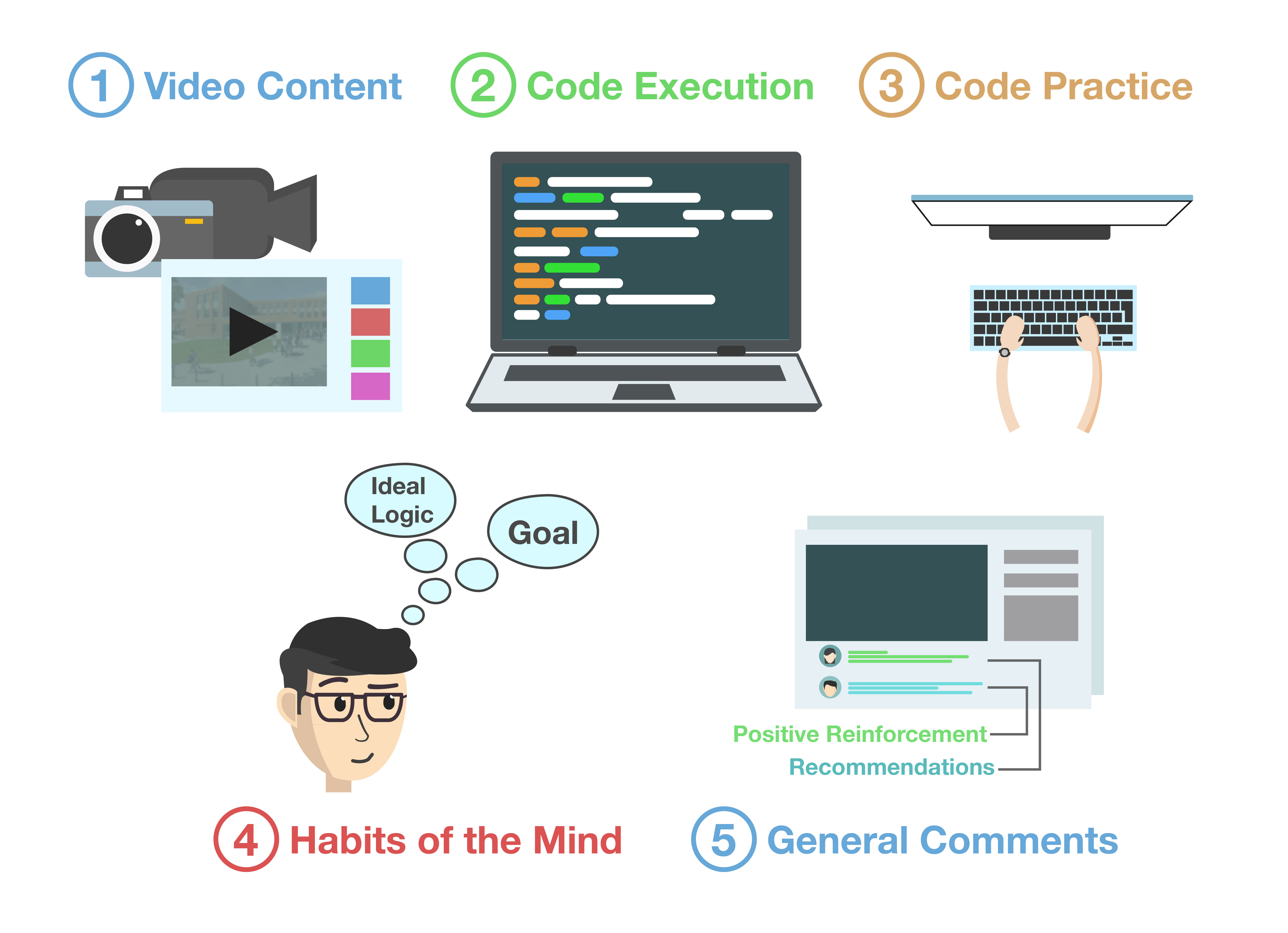
I agree that the code itself: its functionality; its actual use and the overall practice of coding should be assessed, as well as the intentional thinking flow of the students, referred to here as "Habits of Mind". I would also suggest including some of the following, if the project allows:
Therefore, whatever is important o the scope of the project, should be included in the assessment. Students should never be "blind-sided" in the assessment process, especially when their individual confidence, authenticity and creativity is at stake.
Keep up the great work and expand your scope in assessing student learning.
TIP: In any hands-on activity or project, even is coding is being used, the learning, design, development and application processes must all be valued and assessed.
Coming up next, "Everything is preset in current curricula." Stay tuned...
Why is it Important to Have an Inclusive Approach to Teaching and Learning?
So, including all students is important if real inclusion is taking place. Inclusion doesn’t just mean being respectful; and polite to every student. Nor does it only mean knowing each student’s name, even though these are important behaviors for teachers to practice.
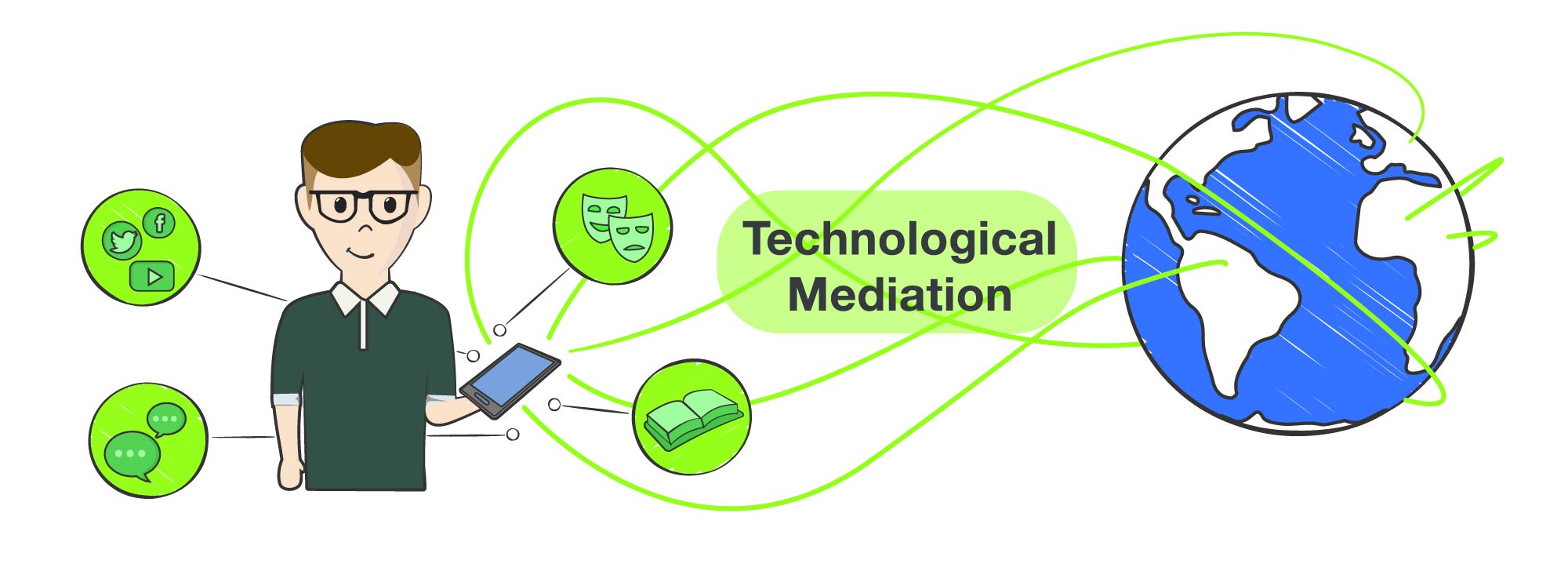
The inclusion that brings results is when the learning styles and preferences, all literacy skills, all intelligences, and cultural differences or even language differences (If that is present in a class group) are all included in the learning process. Of course, not every learning activity or project or assignment will include every aspect of the list above, however, if the instructional design is flexible enough to provide a variety of options and choices to students within each activity or project, more students will be included. New and newer technology mediation and delivery of instruction also provides incredible and vital processing options for students which help support inclusion.
coding provides a variation and options for students to utilize many of their skills while developing others. It is language-based; therefore, literacy is being developed; it is logical and system-based; therefore, analytical skills are being developed; it provides opportunity for creative and innovative thinking to be developed. coding does not have to only be used in computer courses or Math, but it can provide vital learning options and opportunities for students to demonstrate their learning by designing solutions to very real problems, regardless of subject area.
This article states:
True coding education must be fully integrated, cross-discipline and resulting in creatively designed and problem-solving innovations for real world success. This is how we can help transition students from being consumers to being producers and "makers."
coding is a great way to include students and inclusion is vital for student learning success!
TIP: Plan instruction with enough flexibility to include more students.
Coming up next, “This sounds too confusing!” Stay tuned...
Who is Being Included in This Approach?
As we've been discussing inclusion and the challenge to involve every student and to involve teachers in the entire learning process, how does this relate to coding? Can coding really engage teachers and students together?
coding is a perfect fit in engaging teachers and students together in the learning process. coding can provide creative and innovative opportunities while guided by teachers, encouraging students to problem solve, creatively design, and to produce effective and efficient tools, constructions, challenges, and projects. The focus is on moving beyond information only and achieving new knowledge that creates and produces new solutions.
This Article states:
The process of teaching and learning must be about building on what is known and forming what has yet to be formed. This is a dynamic process of integrating experience, information, and knowledge building in a learning process of dynamic transformation for the learner.
The same article refers to the use of technology as follows:
New technology provides excellent opportunities to support the process of knowledge building; however, the successful use of these tools is dependent upon the mindset of the instructor and the design of the instruction.
Therefore, the use of coding brings together the information foundation but moves it forward creatively and innovatively to achieve new knowledge that produces use.
TIP: coding designs can include each student and teacher in producing useful solutions.
Coming up next, "Why is it important to have an inclusive approach to teaching and learning?" Stay tuned...
I Already Challenge My Students to Think!
I remember when I was in grade school, teachers would provide a paragraph and ask us to summarize the entire paragraph into one or two sentences. That was quite a regular skill practice and what it was actually doing was increasing our ability to synthesize information and identify the main points in order to streamline the verbiage. That could not be done at all if the paragraph were not understood, so that is Step 1 – again, check for understanding. Once that has been ascertained, however, the next steps are as follows: Ask your students…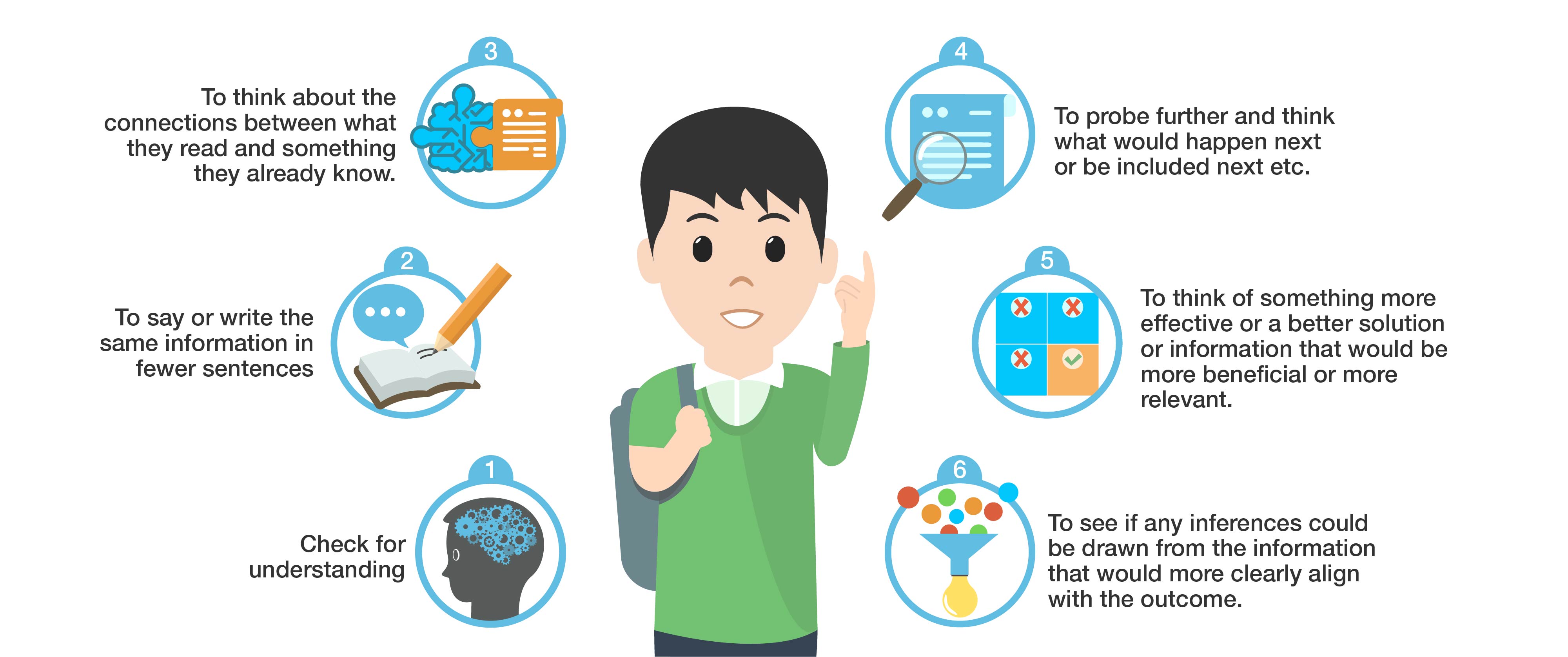
These kinds of thought-expansion and thought-probing questions begin to show how students are thinking about, around, and through the subject area or topic. This kind of intentional focus on thinking is truly beneficial for students in their overall academic and future professional success.
TIP: Rethink how you expand the thinking of your students.
Coming up next, “How can coding help? Most students don’t understand coding.” Stay tuned...
How Can coding Help? Most Students Don’t Understand coding
coding/" target="_blank">
We Are Teachers states, in an article written by Jennifer Williams (2017), that the kinds of skills students learn through coding are not only related to the technology but include, among others listed:
Critical Thinking
Problem Solving
Persistence
Processing Skills
Determination
These are indeed life skills. Amazingly, the processing area of skill development addresses language and literacy as the article suggests:
When you do coding, it really is like a whole new language, which definitely encourages processing skills. It might not be your typical French, Spanish or German class, but this is a universal language. No matter where you go in the world, if you speak code, you’ll be able to communicate, which is pretty cool.
As well, in the general process of the coding projects, these language and literacy skills support the entire process of concept development and design, exploration and discovery and innovation and application. This is truly amazing in its potential!
In an article I wrote on the subject of new ways of thinking, I encourage teachers to focus on the process as much as the actual content when assessing what students are learning and how they are learning it:
Identifying new skills here does not refer to content area as much as process; thinking, interaction, collaboration, communication, application: All represent areas of process. Each of these areas is included in any process of teaching and learning.
That is, teachers being involved in assessment that not only assesses the outcome of the process but the process itself. 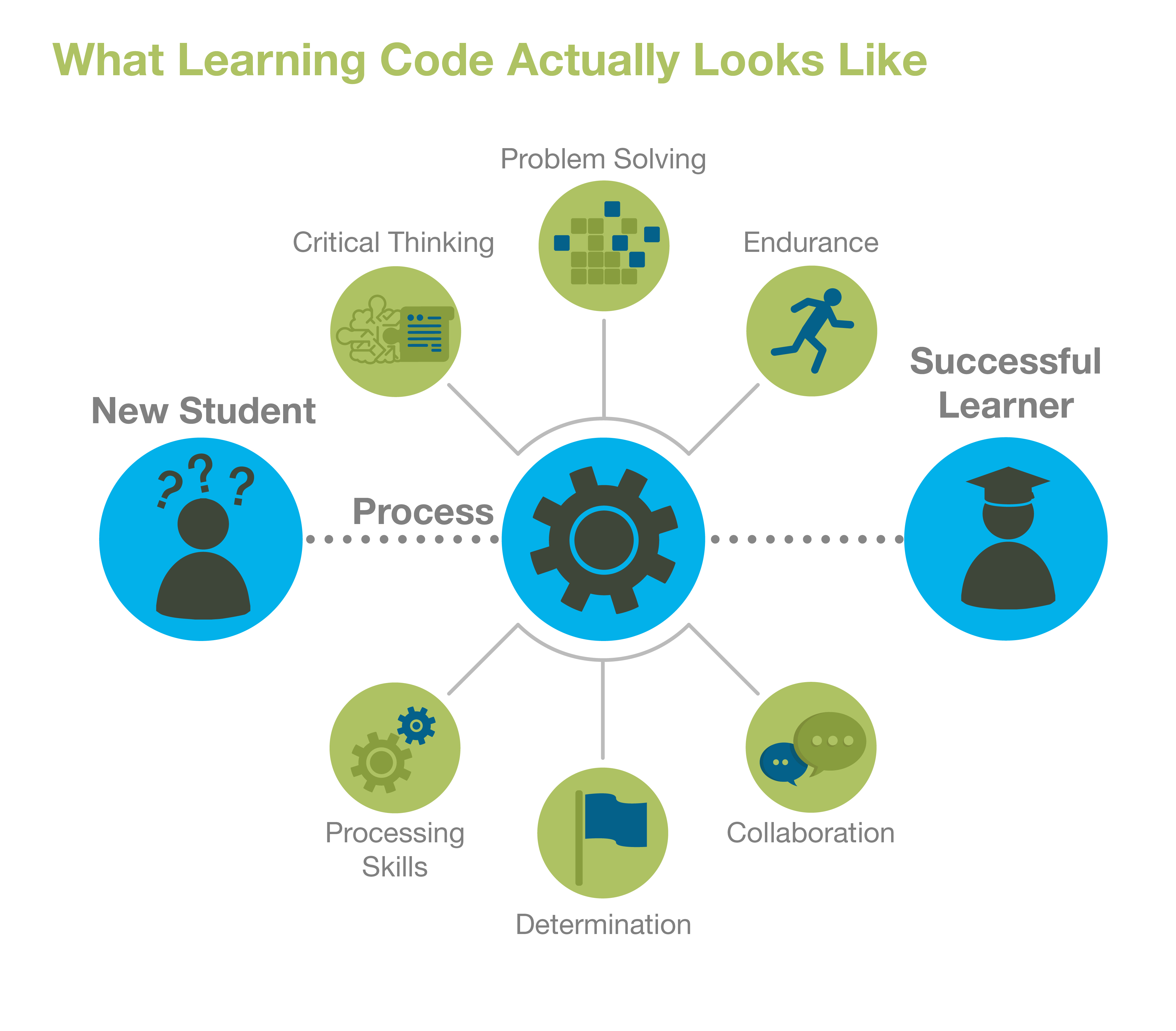
coding provides the “evidence” of a thoroughly thought-through process of reasoning and application in order for the designed outcome or product to be observed.
TIP: Think of coding as the result of a process of thought.
Coming up next, “coding is too difficult for me, so I can’t help students think about it.” Stay tuned...
coding is Too Difficult for Me, So I Can’t Help Students Think About It
In an interesting coding-in-the-classroom-six-tips-to-get-even-reluctant-teachers-and-students-started" target="_blank">EdSurge article by Alexandra Diracles and Katarina Pasinsky (2017), the authors attest to the awareness that most educators currently have of the current challenge of coding for students. The article describes it as follows:
Educators across the globe are increasingly familiar with the staggering statistics: Between 2010 and 2020, STEM jobs growth will outpace all other jobs at 18.7%, leading to an estimated 1.1 million computing jobs by 2024.
The article continues to describe the challenges of lack in overall exposure to coding, lack of gender equity in access to computer coding, as well as lack of diversity in general of teachers who feel prepared to teach coding and this is a challenge for the future of students.
Among the listed “Roadblocks” the article lists for many teachers, are those of teachers feeling overwhelmed or isolated, feeling under-prepared or lacking in knowledge. The reality is that, while these challenges may be very real for many teachers, there are general approaches which can be taken by teachers which will facilitate progress and keep students engaged: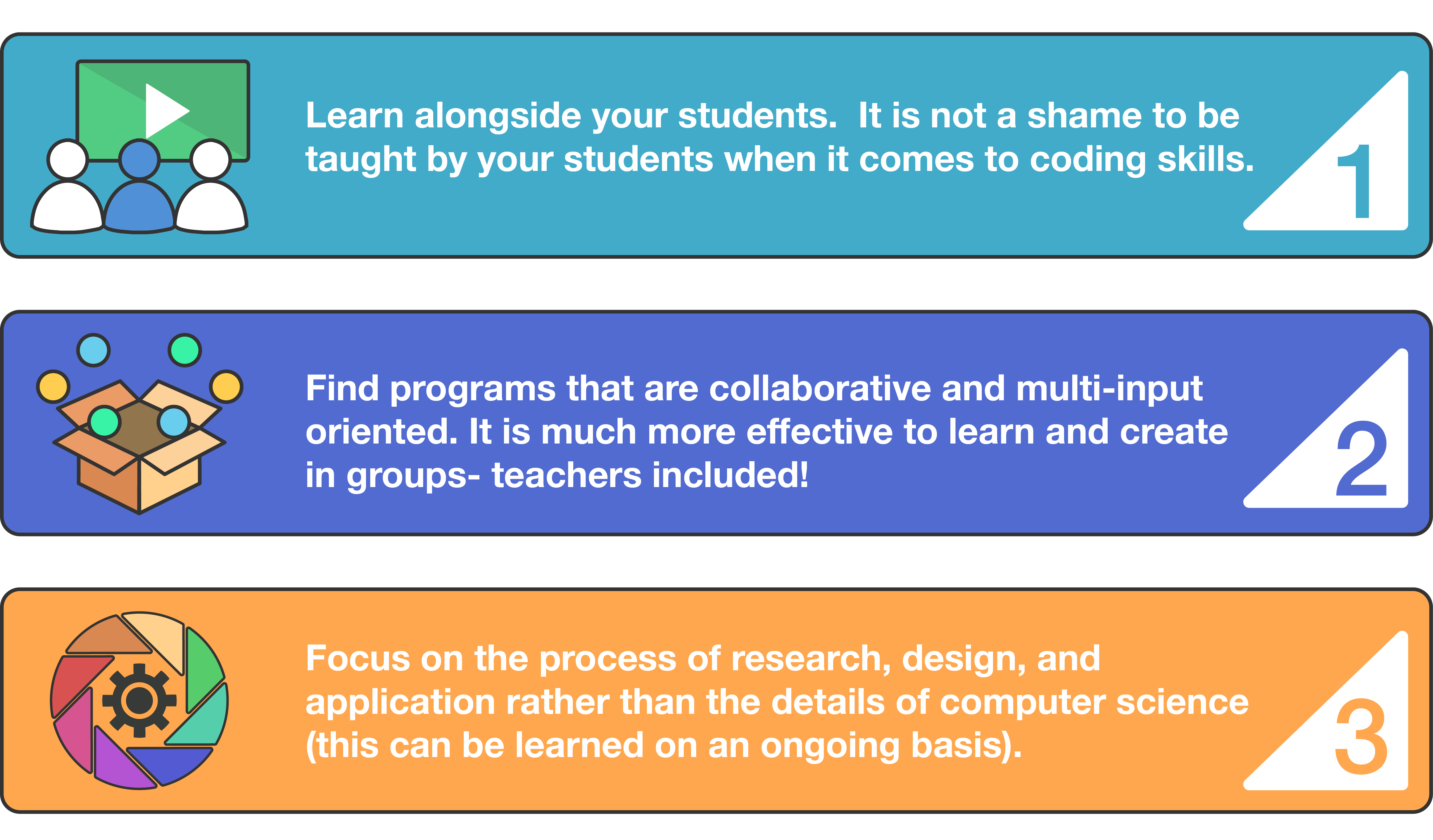
Anomaly Studios is happy to work directly with you and your students to meet those goals!
TIP: Never stop learning and that means you have to start learning to begin with – that includes coding 😊
Coming up next, “How can you assess higher ordered thinking?” Stay tuned...
How Can You Assess Higher Ordered Thinking
Many books and resources exist to provide guidance and support in assessing higher order thinking skills. In this topic thread, we have discussed how coding projects can provide the “evidence” that higher order thinking has taken place in order for the creation, solution, or product to be completed. However, how can the overall thinking process be truly assessed so that teachers and students can become more aware of those processes in planning and implementing new ideas and projects? How can thinking be assessed so that students can realize how and where their thinking should be expanded or probed further?
As in most areas of study or projects of work, the full scope is difficult to quantify in any helpful manner, rubrics provide the most effective way to attempt this. Precisely because rubrics provide the full scope of possibilities, students can then review and understand their own strengths and challenges moving forward and developing stronger thinking skills. What kinds of scope then should be considered?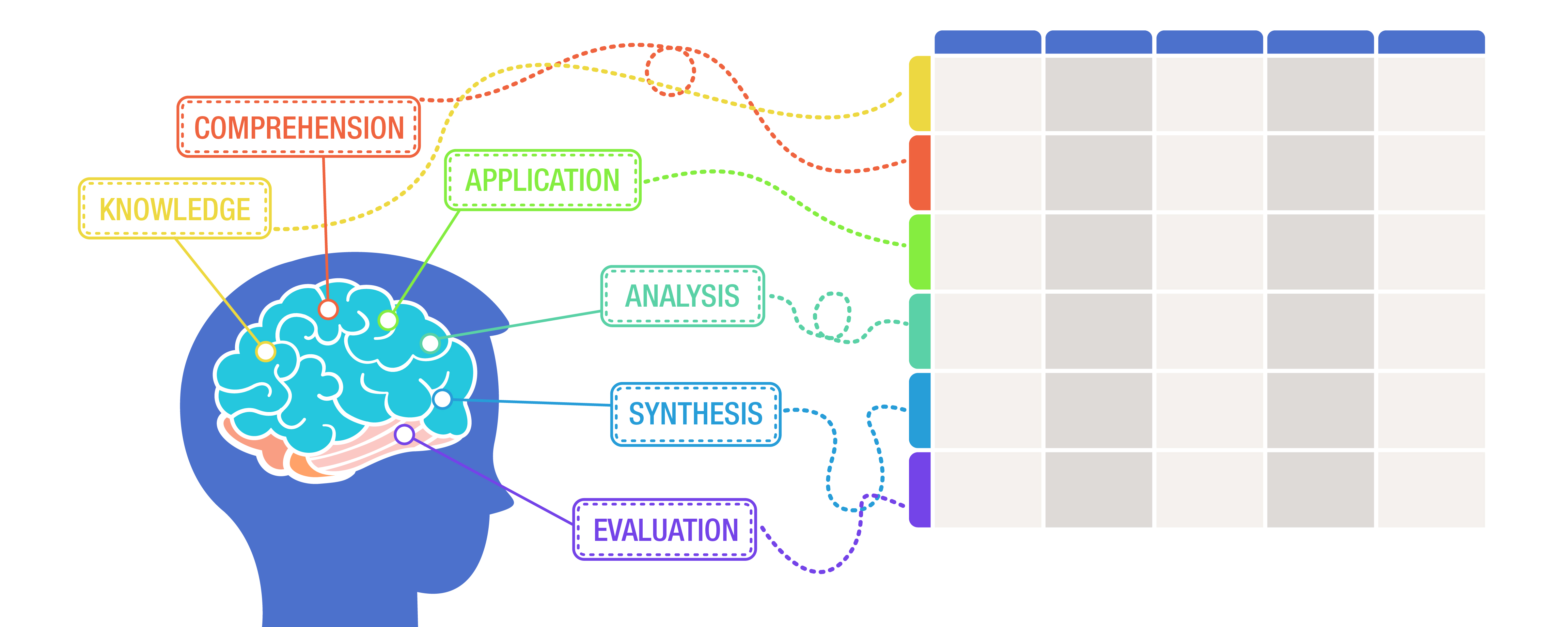
As we have already discussed, there are several main areas of consideration. These should include: understanding/comprehension, analysis, synthesis and application (please review Bloom’s Taxonomy of higher order thinking skills). With new and newer technology (including coding), as well as the pressure of standardized testing, many have modified that list over the years. Regardless, depending on the project, there are many possible thinking skills which could be identified and described on a rubric, so that students can see clearly what is expected and how it can be achieved.
SCRIBD provides a useful rubric outline for your reference. We would love to hear back from you when you create your own to see which thinking skills you think are important to assess.
TIP: Design assessment rubrics that capture the full scope of important thinking skills.
Coming up next, “This level of thinking is only for some students.” Stay tuned...
What Does “New Literacy†Mean?
In many sources, literacy is now referred to as “literacies” as the various skills required in today’s world are so wide in scope. The Current Educator/Innovator, has a helpful article on the subject. The author, Gaby Shelow suggests:
It is no longer acceptable to only teach students what I’ll call classic literacy skills. Of course, these are important, but if we as teachers focus solely on these, we are leaving out a large chunk of literacy skills that are necessary in today’s society, the so-called new literacies.
The author also cites a list of new literacies provided by the National Council of Teachers of English that includes many higher order thinking skills and highly developed abilities in collaboration, global communication, analysis and design. While we may not see many students sitting reading a book, if they are reading online, they are reading within many contexts and multidimensional sources. They cross-reference, inter-analyze and synthesize quickly and relevantly. These are required skills for current and future success. Therefore, rather than a linear beginning and end, it is a multidimensional and highly interactive flow of information towards a synthesized purpose.
In terms if utilizing these skills in learning, the author continues:
Students can’t learn these skills on their own. Just as with any other skill, students need guidance from their teacher and an opportunity to practice these skills in a safe and collaborative environment.
Therefore, while you’re being stretched and challenged to prepare students for preset tests, plan your learning environments to include multidimensional inputs, so that your students can learn and develop the kind of literacy skills they will need to succeed in the future.
TIP: When planning instruction, think about the future success of your students.
Coming up next, “How can new and conventional literacy be supported through coding?” Stay tuned...
How Can New and Conventional Literacy be Supported Through coding?
The purposes and goals of conventional literacy and coding are remarkably similar. An article in coding_as_a_literacy_for_the_21st_century.html" target="_blank">Education Week by Matthew Lynch explains it as follows:
What is literacy? It is the ability to use a symbol system (a programming language or a natural written language) and a technological tool (paper and pencil, or a tablet and computer) to comprehend, generate, communicate, and express ideas or thoughts by making a shareable product (a text, an animation, a robot) that others can interpret. This definition applies to both textual and coding literacy.
The author suggests that the main challenge of STEM education is that it is still mostly reserved for certain subject areas and students. Rather, it should be integrated across disciplines. Mark David writes in an article for the International Literacy Association:
This is the critical point of digital literacy: learners have to engage in the creation of content in order to fully comprehend its messaging. My students practiced decoding through the process of coding, learned syntax as a new vocabulary, and became fluent in a global language of programming. As an educator, the exhilaration of observing students bring creativity to problem-solving is empowering. Students, families, and fellow educators want to share in the excitement of innovation.
The level of action and application is clear, and these skills are extremely important for future success. Students must still be literate in the conventional sense; however, coding can support students in their development of new literacy skills as well. We remember when we were first asked the WHY question by a teacher. That amazing thrill of being encouraged to think individually, integrate existing information with personal ideas and knowledge to produce something new, was powerful. Currently, while that is still the case, we must ask students to identify problems and solve them. Think through limitations and find a solution. Create something new and innovate towards an evolving goal.
coding can provide the tools and the environments within which these new literacy skills can be developed. Reach out so we can work with you to help your students succeed now and prepare for their future.
TIP: coding supports literacy development – think how it can enhance your current courses.
Coming up next, “An Integrated Approach to Academic Standards.” Stay tuned...
I Don’t Teach Philosophy!
An article I recently published with THE Journal states:
We are now being told that younger students should be learning coding for their future, as with increased computerization, Artificial Intelligence (AI), simulation technology, holographic technology, and robotization, many jobs will require employees in various industries and work contexts to be able to code.
However, we should be clear that it is actually computer languages (programming), not only interface design and functionality, that is being referred to as user experience design.
This is not a philosophical idea exchange, this is reality for the future success of our students. Our (Anomaly Studios) solution to provide online access to coding instruction (real computer coding languages) moves students beyond “point and click” and provides an opportunity to innovate, create, and produce designs, solutions, systems, applications that will be relevant and effective, regardless of subject area.
This can be daunting for teachers who do not know these languages, which is why our solution does not require teachers to know the languages, but we work in tandem with the teachers to customize the coding instruction to meet academic standards and provide a truly integrated methodology for students.
Please review our options and let us work with you to move these ideas out of the world of philosophical discussion and into the real world your students are facing in their future. Let us help you help them learn integratively and develop the skills they will need for their future success.
coding Academy" href="https://learn.anomalystudios.com/store" target="_blank">
TIP: Think creatively and provide access for your students to learn and understand integratively.
Coming up next, “I know we have to address problem solving, but it always seems so vague.” Stay tuned...
Keywords: coding, academy
This page redirects to the coding Academy
coding Academy Loading...
How Can You Assess Problem Solving
So, we can agree that problem solving is a necessary skill for current students to develop, but can it really be assessed well? Wouldn’t it be like trying to assess a moving target? These are fair questions, given the moving parameters of the pursuit of problem solving.
It’s really about process and how to assess various stages of a process. It’s also often best observed in projects that build towards an outcome. In 2012, PISA (Programme for International Student Assessment) laid out a framework to help capture the process.
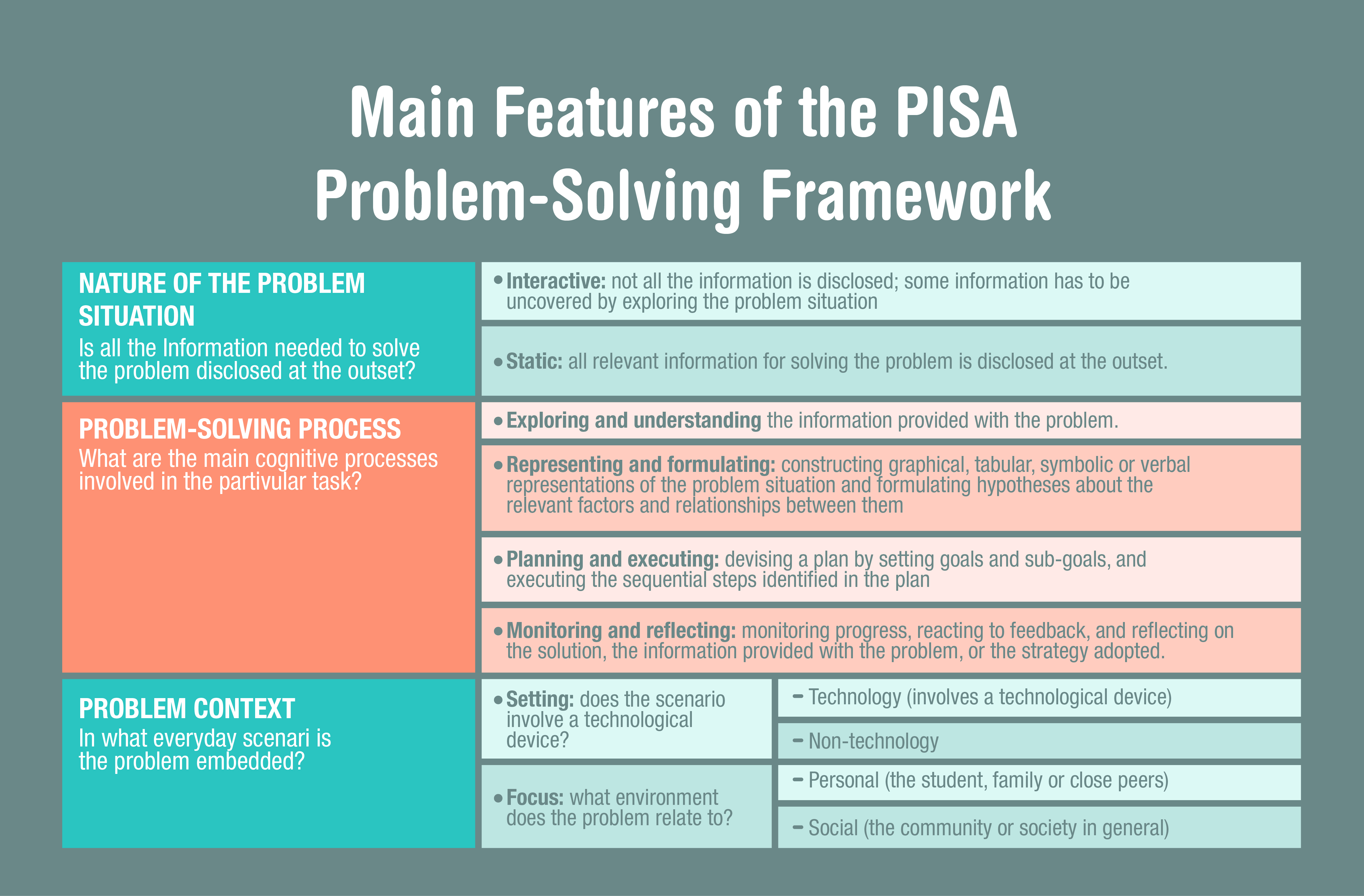
They suggest: Using this framework a problem can be categorized and the problem-solving process (not necessarily linear as shown) described and evaluated.
As you can see, the framework identifies the stages of the process and the application in a real context of use. Therefore, the assessment values each stage of the process as well as the outcome.
TIP: Assessing problem solving values the entire process
Coming up next, “What does coding have to do with problem solving?”. Stay tuned...
What Does coding Have to Do With Problem Solving?
As we continue to think about the connections between coding and problem solving, let’s consider this quote from TechWise:
Solving any complicated problem is rarely done through a straight line. Complicated problems require solving one problem and then the next. Complicated computer programs involve multiple variables, objects, and other moving parts to produce a final result. Sometimes those moving parts will require you to fix something small to get the big result.
Teaching loops in computer programming allows us to bring these principles to our students. We help students manually work through the entire process of the problem. It produces more lines of code, and it helps them see a pattern and see how the pattern solves little problems along the way. Finally, they can translate the pattern into a loop which accomplishes the same goal in less lines of code. Many times they include some form of debugging somewhere in the middle.
Or as we at Anomaly state:
The Anomaly Learning platform teaches students how to be critical thinkers and problem solvers while developing skills in technology and coding
What is interesting about coding or computer languages is that these are directional and constructive codes that produce items, shapes, real world designs and products that can be used and applied within certain criteria and provide the solution required. Also, codes can be creatively used, interactively used and innovatively used; there are no preset limits to what can be coded. The designer/user/student is who uses the codes to produce what is required and what is to be utilized. Therefore, this is observing the process of problem solving from start to finish. That is really cool!
coding improve problem solving?" src="https://anomalystudios.com/assets/images/blog/week49/Week-47-52-Nurture-sequence-06.jpg" alt="Can coding improve problem solving?" width="850" height="1117" />
TIP: coding isn’t confined by a problem, it responds to a problem.
Coming up next, “I already address problem solving in my lesson plans.” - Stay tuned...
Description: I used to think a membership required a massive content library. In reality, every membership fits one of three models: content-driven, community-driven, or coaching-driven. Choosing the right one accelerates momentum fast.
NET Translation:
Model & Offer: Model Complexity
I wasted nearly ten years building a membership that never launched. To put it in perspective, that’s roughly the time it took to build the majority of the parthenon in Greece.
Why did this happen? Not because I lacked expertise. Not because I didn't have an audience. But because I convinced myself it needed to be massive before it could matter.
Every week, I'd add more modules to my plan. More bonus content. More community features. More automation sequences. My planning document grew to 47 pages. My content calendar stretched two years into the future.
And I had zero paying members.
The irony was suffocating. While I was busy architecting the perfect membership empire, entrepreneurs with simpler ideas and clearer focus were already serving members and collecting monthly revenue.
Here's the faulty mental formula that tripped me up: complexity equals credibility.
I thought a membership with three video lessons looked amateur. I thought members would judge me for not having a massive content library, intricate tier structures, and sophisticated gamification systems.
I was wrong. Dead wrong.
In the next few minutes, you'll discover why thinking your membership must be huge is actually preventing you from launching, the three simple models every successful membership fits into, and the exact framework for identifying which model matches your strengths and your audience's transformation.
This is for you if you're overbuilding before you've validated anything with real members, if you feel overwhelmed by all the features you think you need to compete, or if you know your expertise could help people but the complexity is keeping you stuck.
For nine months, my membership existed only on whiteboards and in spreadsheets.
I had mapped out learning paths for three different skill levels. I had designed badge systems, progress tracking dashboards, and certification programs. I had outlined quarterly challenges, monthly themes, and weekly deliverables that would keep members engaged for years.
My feature list included forums, live coaching calls, resource libraries, member directories, private podcasts, bonus workshops, accountability pods, and a mobile app roadmap.
And through all of that planning, I never asked the most important question: "What's the simplest version that could help someone today?"
The planning felt productive. It looked like progress when I spent time color-coding my content calendar. But underneath all that busy work, I was simply terrified of launching something real.
Complexity was my shield. If I never finished building, I'd never have to face the possibility that people might not want what I'd created.
The breaking point came one Tuesday afternoon.
I was sitting at my desk, staring at yet another flowchart mapping member journeys through my elaborate content structure. My coffee had gone cold hours ago.
My wife walked past my office. "Still working on the membership?"
I didn't look up. "Just finalizing the tier structure. Maybe another week or two."
She paused in the doorway. "You said that three months ago."
The words hit like cold water to the face.
I opened my project folder. Nine months of planning. Thousands of dollars spent on courses about membership design. Dozens of competitor sites analyzed. And the only thing I'd actually built was an intimidating, overwhelming, unfinished monument to overthinking.
That's when I finally admitted the truth: I wasn't building a membership. I was building an excuse to avoid launching.
The next day, I swallowed my pride and reached out to a mentor who'd successfully launched multiple memberships.
"I'm stuck," I confessed. "My membership plan is 47 pages long and I haven't launched. I keep adding features but I can't seem to finish anything."
He laughed. Not mockingly, but with recognition. "Let me guess. You're trying to compete with memberships that have been building content for five years?"
"I just want it to be valuable enough that people will actually pay for it."
"Stop right there," he said. "Every membership in the world fits into one of three simple models. Pick one and launch it this month."
I started to protest. Surely successful memberships were more sophisticated than that.
"Name five memberships you admire," he challenged.
I listed them. A fitness program. A business mastermind. An art tutorial site. A productivity system. A writing community.
"Every single one you just named is either giving people content to consume, community to connect with, or coaching to transform them. Content, community, or coaching. That's it. Everything else is decoration."
That single insight shattered my complexity prison.
Over the following weeks, I couldn't stop seeing this pattern in successful memberships around me.
A service professional built a thriving membership around monthly group coaching calls and a private forum where members supported each other. No massive content library. No elaborate tier structure. Just consistent coaching and authentic community. Hundreds of members paying monthly because the transformation was tangible and the connection was real.
A creative educator built a membership focused entirely on weekly tutorials and technique breakdowns. Members could learn and practice at their own pace without social pressure. No live calls. No required community interaction. Just exceptional content delivered consistently.
A consultant built a membership that was essentially a growing library of templates, frameworks, and systems members could implement immediately. Monthly content drops added new resources. No coaching. No community interaction necessary. Members joined for the tools and stayed for the expanding collection.
The pattern was undeniable: the most successful memberships weren't trying to be everything to everyone. They were excellent at one specific thing.
Here's the truth most membership gurus won't tell you: every membership, no matter how big or polished, fits into three simple forms.
The mainstream advice tells you to create an all-in-one membership experience. This is like trying to be a restaurant, gym, and library all at once. It sounds impressive, but it's a recipe for mediocrity.
The reality is simpler and more powerful.
Choose from Content-driven, Community-driven, Coaching-driven. Then later mix and match.
When I understood this, everything shifted. I stopped feeling like I had to build an empire. I just had to pick the model that aligned with my strengths and my audience's deepest needs.
Think of membership models as vehicles. You wouldn't try to build a car-boat-plane hybrid for your first launch. You'd choose the vehicle designed for the terrain you need to cross.
Every membership fits into one of three categories.
This is the library model. Members pay for organized, high-quality resources they can access on their own schedule.
What it looks like: video lessons, templates, frameworks, courses, tutorials, guides, toolkits, recorded workshops. Members consume at their own pace. Your primary job is creating and curating excellent educational content. It can also include apps, software-as-a-service platforms, or AI tools.
But here’s the evolution:
The Access Model is no longer limited to a content library.
It can also be paid access to a proven workflow.
Instead of simply giving people information, you give them a structured path and a trackable, step-by-step framework they move through. That might include implementation checklists, milestone dashboards, guided sequences, or even an AI tool that helps them apply your methodology in real time.
In other words, members are not just consuming content. They are executing a system.
You are not just selling knowledge. You are selling access to a tested process that produces results.
Think of this as the reliable car. It efficiently transports people from confusion to clarity through structured content they can consume on their timeline.
When it works best: You're an educator who loves teaching and creating learning materials. Your audience wants self-paced learning without time pressure.
The advantage: Highly scalable because one piece of content serves unlimited members. You can build while you sleep, creating assets that work for you continuously.
The critical pitfall: Don't drown members in volume. One well-executed training beats ten mediocre ones every time.
This is the gathering place model. Members pay for access to other people on the same journey, facilitated and guided by you.
What it looks like: forums, group calls, peer accountability structures, networking opportunities, shared experiences. Members primarily interact with each other. Your job is creating the space and culture where transformation happens through connection.
Think of this as the bus. You're all traveling together, supporting each other, sharing the experience. The energy comes from the group, and the destination feels more achievable because no one is traveling alone.
When it works best: You're a natural facilitator who energizes groups and builds culture. Your audience craves belonging, peer support, and shared accountability.
The advantage: Naturally engaging and sticky because members create value for each other. Your role shifts from constant content production to thoughtful culture stewardship.
The critical pitfall: You don't have to generate non-stop conversation. Set the culture, ask the right questions, and let the community carry the momentum.
This is the guided journey model. Members pay for your direct expertise applied to their specific situations.
What it looks like: group coaching calls, hot seat sessions, live Q&A, personalized feedback, implementation support. Members get regular access to your attention and expertise.
Think of this as the plane. Premium, personalized transportation that covers ground faster through direct expert intervention. Members get where they want to go faster because you're navigating the most efficient route based on their specific situation.
When it works best: You're a consultant or coach who loves solving problems in real-time. Your audience needs customized guidance for their unique situations.
The advantage: Premium pricing because direct access to expertise is genuinely scarce and valuable. Creates deep impact through individualized attention.
The critical pitfall: Don't overcommit your time. Set clear boundaries for availability. The scarcity of access actually increases the perceived value.
You don't need all three models. You need one model that matches your natural strengths and delivers your audience's desired transformation.
I thought my membership needed video lessons and community forums and coaching calls and resource libraries and certification programs. I was trying to build a car-boat-plane hybrid before I'd ever successfully driven a car.
When I finally chose one model, everything accelerated.
I picked the Access Model because I genuinely love creating educational content and my audience wanted self-paced learning they could fit around their schedules. I launched with nine video lessons, three implementation templates, and a clean member portal.
No community forum. No coaching calls. No elaborate tier system. Just focused, valuable content organized for clear transformation.
The simplicity gave me momentum I never had when I was trying to build everything at once.
Today, my membership doesn't attempt to be everything. It excels at one thing: delivering high-quality, well-organized educational content that creates genuine transformation.
I launch fresh content monthly with automation instead of planning theoretically for years. I serve hundreds of members with a model that scales naturally without requiring my constant presence.
I'm not claiming my model is universally superior. I'm claiming that choosing one clear model is what finally unlocks forward movement and revenue.
Some of my most successful peers run thriving Community Models with minimal pre-produced content. Others run premium Coaching Models with intentionally small cohorts and significantly higher pricing. The specific model isn't what determines success. The clarity of choosing one and executing it well is what unlocks sustainable growth.
My business grew when I stopped trying to build an impressive monument and started operating a vehicle that actually moved.
If your membership feels overwhelming right now, you're not failing at entrepreneurship. You're just trying to build all three vehicles simultaneously before you've successfully driven one.
The entrepreneurs launching this month aren't smarter or more prepared than you. They simply picked one model and committed to making that single model excellent.
Your expertise is ready. Your audience exists and is waiting. The only missing piece is the decision to radically simplify.
Before you close this article, answer these three questions:
Which model genuinely matches your natural strengths? Do you love creating educational content, facilitating group connection, or solving specific problems through direct coaching?
Which model does your audience's transformation actually require? Do they primarily need organized information, supportive community, or personalized guidance?
Which model can you realistically launch in the next 30 days? Not eventually. Not someday when you're ready. Which one can you launch next month and start serving real paying members?
Your honest answers reveal your starting point. Don't second-guess them. Don't overcomplicate them. Just choose and build.
Which of the three models feels most natural to how you already deliver value? And what has been the real thing keeping you from launching? Drop your answer in the comments.
I created a resource called the Membership Model Picker, a straightforward framework that helps you identify which of the three models best fits your unique strengths and your audience's specific transformation needs. It walks you through the exact questions I desperately wish someone had asked me before I spent nine months overcomplicating everything.
Send me a message and I'll get it to you.
That's it for today's installment. Tune in next time and I'll be showing you how to choose the right membership model for your specific business situation and avoid the common traps that derail even experienced entrepreneurs.
This article, images, and podcast were created with AI assistance. If you would like to learn my process of how I go on walks, talk out my ideas and data mine my thoughts to create content and then automate my vocal performance with 11Labs, you can sign up for my free content creation masterclass here and I'll show you the way. Learn how I've turned over 7 million steps, walking over 3,760 miles into a content generation machine and use AI to data mine my thoughts and generate and polish my content and ideas while getting great exercise outdoors.
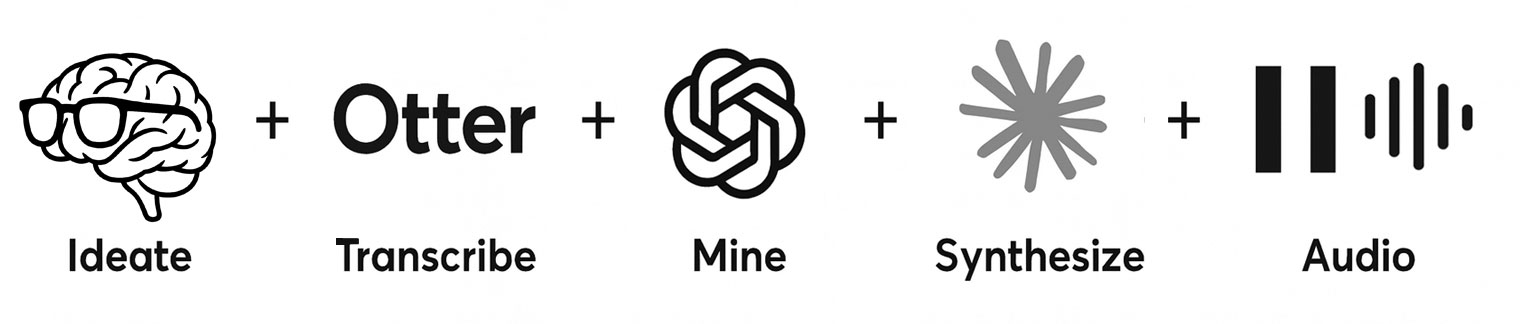
Verse Intro: anomalystudios001/2026-2-28-15-18-42-009 - Memberships Mastery Podcast Week 9.mp3